

Sub-Total: $0.00
How to Identify Rare Music Albums: A Collector’s Guide
Table of Contents
- Start with a Proven Workflow for Identifying Rare Music Albums
- How to Identify Vinyl Record Pressings Using Labels and Runout Codes
- How to Find a Vinyl Record Catalog Number and Matrix Number
- Vinyl Record Grading Guide: How Condition Affects Value
- The Best Free App for Cataloging Vinyl Records and Tracking Rare Finds
- Spotting Counterfeits, Bootlegs, and Unofficial Releases
- Valuing Rare Music Albums with Completed Sales and Condition Comparisons
- Frequently Asked Questions
Last Updated: October 19, 2026
Start with a Proven Workflow for Identifying Rare Music Albums
Spotting rare music albums is not about luck. It is about slowing down and checking four things in the same order every time.
The same mistake shows up again and again: people judge a record by its cover alone. The cover tells you almost nothing.
Here is the workflow we use on every record that comes through our door:
- Inspect the cover and sleeve for wear, stickers, and printing details.
- Check the disc and runout groove for etched codes.
- Match the label and catalog number to a known pressing.
- Grade the condition before you assign any value.
Follow those steps in order and you will avoid most false alarms. Skip them and you will mistake a common reissue for a rare music album worth far more.
Inspect the Cover and Sleeve First
Start with the outside. Look for seam splits, ring wear, cut-out corners, and price stickers. A promo stamp or a “not for resale” mark can point to a promo copy, which some collectors chase and others avoid.
Flip the sleeve over. Check the printing quality of the artwork and text. Early pressings often have sharper print and different back-cover layouts than later reissues. Note any cover variation, because small differences here matter later.
Check the Disc and Runout Groove
Now pull the record out. Hold it under good light and tilt it until you can see the smooth area between the last song and the label.
Look for etched letters, numbers, and symbols. These runout codes are the record’s fingerprint.
Write down exactly what you see. Do not guess or rely on memory. A single letter difference can separate a first pressing from a later one.
Pro Tip
Photograph the runout area with your phone and zoom in. Etched codes are faint, and a photo makes it easy to compare your copy against database entries later without handling the record again.
Photograph the runout area with your phone and zoom in. Etched codes are faint, and a photo makes it easy to compare your copy against database entries later without handling the record again.
How to Identify Vinyl Record Pressings Using Labels and Runout Codes
Learning how to identify vinyl record pressings comes down to two clues: the label and the runout code.
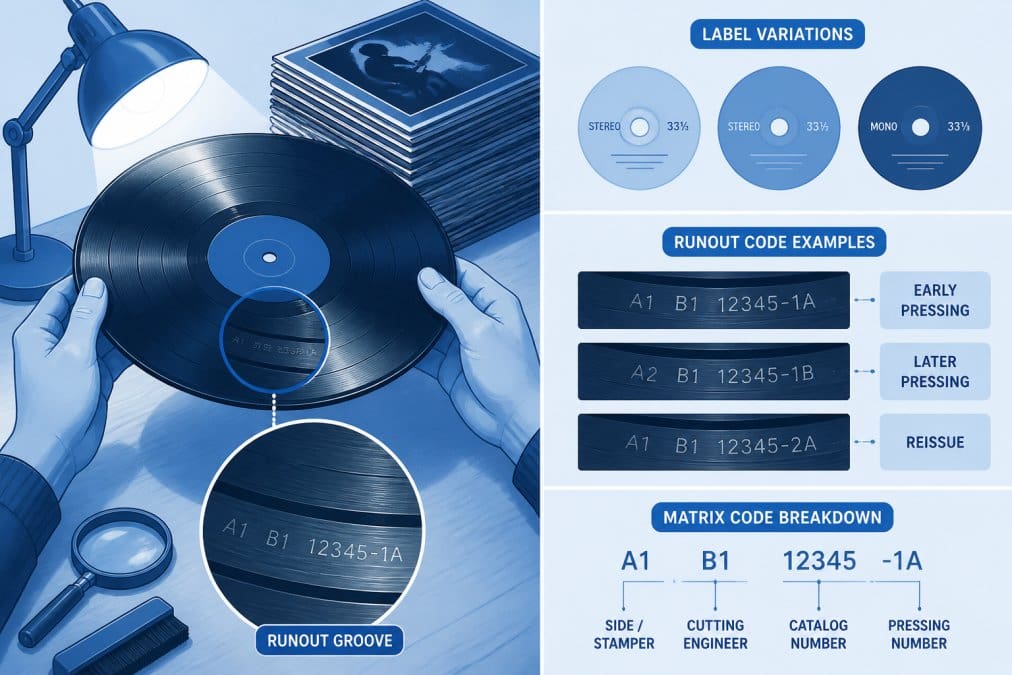
Labels change over time. A label variation, such as a different logo, color, or text layout, often marks a specific era or pressing plant.
The runout groove holds the deepest detail. Look for:
- Etched codes that identify the mastering engineer or plant
- Stamped codes pressed into the vinyl rather than cut
- Initials or symbols that match a known cutter
- A trailing letter or number that marks a specific stamper
Compare what you find against a record database. If the label and runout code match a documented first pressing, you likely have an original pressing.
How to Find a Vinyl Record Catalog Number and Matrix Number
Finding a vinyl record catalog number is simple once you know where to look. The catalog number is the label’s ID for that release, and it usually sits on the spine, the back cover, and the record label itself.
The matrix number is different. It is etched or stamped in the runout groove and identifies the specific lacquer cut used to press your copy.
Use this quick reference:
| What to Check | Where to Find It | What It Tells You |
|---|---|---|
| Catalog number | Spine, back cover, label | The label’s release ID |
| Matrix number | Runout groove | The specific cut and stamper |
| Label design | Center label | The era and pressing plant |
| Country of release | Back cover, label text | Where it was manufactured |
A Worked Example of Matching a Release
Suppose you pull a record with catalog number ABC-1234 on the spine and back cover. That number narrows the field, but it does not confirm the pressing.
Now read the runout. You might see something like ABC-1234-A 1A on one side and ABC-1234-B 1B on the other, with a small stamped symbol near the label.
A common pattern is that the first pressing carries one runout suffix and later stampers add a trailing letter or number.
Watch Out
Do not trust a catalog number alone. The same catalog number can cover many pressings made across years and countries. Only the matrix number and runout code confirm which one you actually hold.
Do not trust a catalog number alone. The same catalog number can cover many pressings made across years and countries. Only the matrix number and runout code confirm which one you actually hold.
Beyond Vinyl: Catalog and Matrix Clues on CDs and Cassettes
The same matching logic applies to other formats, even though the markings look different. On a CD, check the matrix string etched into the inner hub and the IFPI codes stamped near the center hole.
Across every format, the rule is the same: match the catalog number, the format-specific code, the label or shell design, the country, and the date together.
Vinyl Record Grading Guide: How Condition Affects Value
A vinyl record grading guide matters because condition drives value more than rarity in many cases. A rare record in poor shape can be worth less than a common one in mint condition.
Grade the vinyl and the sleeve separately. Buyers care about both, and a clean disc in a torn sleeve is a different sale than the reverse.
The Goldmine Grading Scale Explained
The Goldmine grading scale is the standard most collectors and dealers use. It runs from Mint down to Poor:
- Mint (M): Sealed or flawless, essentially as new
- Near Mint (NM): Nearly perfect, with one or two tiny flaws at most
- Very Good Plus (VG+): Light wear, plays clean with minor noise
- Very Good (VG): Noticeable wear and some surface noise, still playable
- Good (G): Heavy wear, plays through but looks rough
Be honest and slightly conservative. Overgrading is the fastest way to lose a buyer’s trust, and it is the most common mistake we see when people bring collections in to sell.
The Best Free App for Cataloging Vinyl Records and Tracking Rare Finds
The best free app for cataloging vinyl records is Discogs. It has a huge user-built database, and you can scan barcodes or search by catalog number to match your copy.
But an app is only as good as the workflow you run through it. Most people search by album title, pick the first result, and move on. That is how a common reissue gets logged as a rare original.
A Repeatable Identification Workflow Across Formats
- Photograph the release before you search. Capture the front cover, back cover, spine, both labels or the disc face, and the runout groove or matrix area. Photos let you compare details later without handling the item again.
- Record the catalog number and format-specific code. For vinyl, that means the catalog number plus the full runout string. For CDs, the inner-hub matrix and IFPI codes. For cassettes, the shell text and J-card catalog number.
- Match the exact release entry, not the title. In the database, filter by format, country, release year, and label. Open the entry and compare its photos and notes against your own photos.
- Verify the variant. Many database entries list multiple runout or matrix variants. Confirm your code appears in the variant list for that entry. If it does not, you may have an undocumented pressing.
- Grade and log condition. Record the vinyl or disc grade and the sleeve grade separately so your catalog reflects reality.
- Compare completed sales. Pull recent sold prices for that exact entry in a similar grade, not asking prices.
Distinguishing a Rare Release from a Common Album in a Different Pressing
The trap is relying on the album title. A famous album may have sold millions of copies, yet one early pressing with a specific runout, label design, and country can be genuinely scarce.
A few habits make cataloging easier:
- Add the exact pressing, not just the album title
- Note the matrix number or format-specific code in your listing
- Grade your copy honestly when you log it
- Keep a want list so you can spot upgrades
- Re-check completed sales periodically, because demand shifts
If you would rather browse in person than scroll a database, come see us. Our shelves are stocked with vinyl, books, movies, and games, and we are always happy to talk through a record you are unsure about.
Spotting Counterfeits, Bootlegs, and Unofficial Releases
Counterfeits and bootlegs exist, and they fool people because they look close to the real thing. A bootleg is an unauthorized pressing, and a counterfeit copies official artwork and labels to pass as genuine.
Watch for these warning signs:
- Blurry or low-quality label print compared with a known original
- Wrong fonts or spacing on the label text
- Missing or mismatched runout codes for the claimed pressing
- Thin, flimsy sleeves that feel wrong for the era
- Odd colors or weights that do not match documented releases
Authenticate by comparing every detail against a trusted database entry. If the label, matrix number, and runout code do not line up with a documented release, treat it as unofficial until proven otherwise.
The runout groove is your best defense against fakes. Counterfeiters copy the cover and label, but they rarely get the etched matrix codes right. Always check the runout before you pay a premium.
Valuing Rare Music Albums with Completed Sales and Condition Comparisons
Valuing rare music albums means looking at what copies actually sold for, not what sellers are asking. Asking prices are wishes. Completed sales are facts.
Use recent sale price data from a record database, then adjust for condition. Compare your copy only against sales of the same pressing in similar shape.
Here is how to appraise a record:
- Confirm the exact pressing using the catalog and matrix numbers.
- Grade the vinyl and sleeve separately.
- Pull completed sales for that pressing in a similar grade.
- Average the recent sales and adjust for your condition.
- Factor in demand for the artist and genre.
If you are sorting a collection and want a fair offer, bring it in.
Frequently Asked Questions
Which albums are worth money?
Albums worth money typically have a combination of low pressing quantity, high collector demand, and excellent condition. First pressings of classic rock, jazz, and blues records often command high prices, especially if they include original inserts or shrink wrap. Promo copies and test pressings can be even more valuable. To determine if your album is worth money, check completed sales on sites like Discogs or eBay, verify the catalog number and matrix codes, and grade the condition honestly. Rare music albums from the 1950s through the 1970s are often the most sought after.
How do I know if my vinyl is rare?
You can tell if your vinyl is rare by checking several factors: the pressing quantity (limited runs are rarer), the country of release (some foreign pressings are scarce), label variations, and whether it’s a first pressing or original edition. Look for promo stamps, test pressings, or misprints. Also, research the album on collector databases to see how many versions exist and which one you have. Condition matters too; a mint copy of a common album can be rarer than a worn copy of a rare one. Start by finding the catalog number and matrix number, then compare with known rare pressings.
What is the best free app for cataloging vinyl music?
Discogs is widely considered the best free app for cataloging vinyl records. It has a massive database of releases, allows you to scan barcodes, and lets you track your collection’s value. You can also use it to create a want list and connect with other collectors. Other options include CLZ Music, which offers a free version with limited features, and Discographic, which syncs with Discogs. For a free, comprehensive solution, Discogs is the go-to choice for both beginners and serious collectors.
Does a record’s condition affect its value?
Yes, condition is one of the most important factors in a record’s value. A vinyl record grading guide like the Goldmine standard ranges from Mint (M) to Poor (P). Even a rare album in Poor condition may be worth a fraction of a Near Mint copy. Sleeve condition also matters; splits, ring wear, and writing can reduce value. Always grade conservatively and note any flaws. When valuing rare music albums, compare your copy to recently sold listings in similar condition to get an accurate estimate. Proper storage and handling help preserve condition and value.
Sorting a collection takes patience, and getting the details right takes practice. Whether you are chasing a first pressing or just want to rediscover albums from your youth, the right tools and a careful eye make all the difference. At Greatest Hits Music & Books, we offer a huge selection of records, books, movies, games, and nostalgic finds, plus cash for books and store credit for your pre-loved media. Stop by our Tupelo store to browse our collection and find your next treasure.