

Sub-Total: $0.00
How do you preserve antique book collections?
Last Updated: October 25, 2026
Quick Summary
To preserve antique book collections, store books in a climate-controlled room at 60-70°F and 30-40% relative humidity, keep them upright with proper support, and handle them carefully with both hands. Avoid basements, attics, direct sunlight, and moisture sources, and monitor conditions with a digital hygrometer to catch environmental problems before they damage your books.
- Store books upright with bookends in interior rooms, never in basements or attics which flood and experience extreme temperature swings
- Maintain temperature between 60-70°F and relative humidity between 30-40%, with stability mattering more than perfection
- Install a digital hygrometer to monitor conditions weekly; mold thrives above 50% humidity and causes permanent damage
- Handle books with both hands, supporting the spine from underneath, and never pull books from tightly packed shelves
- Use acid-free archival boxes for valuable books and isolate any book showing mold, pest damage, or water exposure before consulting a conservator
Table of Contents
- How to Preserve Antique Book Collections: The Essentials
- Choosing a Suitable Storage Location for Rare Books
- Rare Book Storage Conditions: Temperature and Humidity
- How to Store Rare Books Upright and Properly Supported
- How to Handle Old Books Safely and Prevent Damage
- Using Archival Book Storage Boxes and Protective Enclosures
- Assessing Condition, Responding to Damage, and When to Seek Professional Help
- Start Protecting Your Collection Today
- Frequently Asked Questions
How to Preserve Antique Book Collections: The Essentials
To preserve antique book collections, you need to understand a few core principles. Temperature swings, humidity shifts, and direct sunlight are the main threats to rare books. At Greatest Hits Music & Books, we work with collectors who want their treasured volumes to last for decades.
This guide covers choosing storage locations, controlling environmental conditions, supporting books correctly, and responding when damage occurs, practices that protect any collection, from a handful of first editions to a sprawling library.
Choosing a Suitable Storage Location for Rare Books
Basements and attics are tempting for their space but are the worst choice for rare books: basements flood, attics bake and freeze, and both swing wildly in humidity.
Instead, pick a room you live in, a bedroom closet, interior hallway, or spare room. These stay stable because they’re insulated from outside temperature swings.
Keep books away from:
- Direct sunlight (causes fading and paper deterioration)
- Kitchens and bathrooms (moisture and temperature changes)
- Basements (water damage risk and humidity swings)
The best storage location is cool, dry, and stable. A closet in a temperature-controlled room beats a fancy bookcase in a sunny living room every time.
Rare Book Storage Conditions: Temperature and Humidity
Most collectors focus on temperature and ignore humidity, or vice versa. Both matter equally for preserving antique book collections, and their relationship determines whether paper, leather, and adhesive stay stable.
Aim for these targets:
- Temperature: 60-70°F (ideally holding steady around 65-68°F)
- Relative humidity: 30-40% (never above 50%, never below 25%)
Stability matters more than perfection. A room that stays at 68°F and 35% humidity is better than one that swings between 60-75°F and 25-50% humidity. Constant fluctuation stresses book materials and causes warping, cracking, and mold growth.
Why the two numbers work together
Relative humidity is temperature-dependent: warm air holds more moisture, so the same absolute moisture reads as lower relative humidity when the room warms (What Is Humidity? | NESDIS). As temperature swings, so does relative humidity, and book materials absorb and release moisture trying to equilibrate. Paper expands across the grain when it absorbs moisture and contracts when it dries; repeated cycles cause cockling, joint failure, and foxing.
How to monitor conditions
- Install a digital hygrometer/thermometer at shelf height, away from exterior walls, windows, and vents.
- Log readings weekly at the same time; the pattern matters more than any single reading.
- Calibrate or replace inexpensive hygrometers periodically, many drift several points a year. The salt test works: seal the sensor with a saturated salt solution and compare to the known equilibrium value.
What to do when conditions drift
- Humidity above 50%: Run a small dehumidifier with a humidistat set to your target range, keep the door closed, and check for sources, a damp wall, nearby bathroom, or leak. Don’t open windows on a humid day; that usually makes it worse.
- Humidity below 25%: A room humidifier can help, but avoid directing mist at the books. In dry winter climates, keeping the door closed and away from forced-air heat often does more than adding moisture.
- Temperature swings: Avoid shelves against exterior walls or above heat sources, and don’t constantly adjust the thermostat; a steady setting beats a “perfect” one that changes daily.
Watch Out
Mold thrives in humidity above 50%. If your storage area gets damp, address it immediately. Mold damage is permanent and spreads to adjacent books. Do not run a fan over a moldy book in the storage room, that can distribute spores to the rest of the collection.
Mold thrives in humidity above 50%. If your storage area gets damp, address it immediately. Mold damage is permanent and spreads to adjacent books. Do not run a fan over a moldy book in the storage room, that can distribute spores to the rest of the collection.
Key Takeaway
Buy an inexpensive digital hygrometer before you buy anything else. You cannot manage what you do not measure, and a $20 monitor plus a weekly log will catch most environmental problems before they damage a book.
Buy an inexpensive digital hygrometer before you buy anything else. You cannot manage what you do not measure, and a $20 monitor plus a weekly log will catch most environmental problems before they damage a book.
Maintain these environmental targets to keep paper, leather, and adhesive stable over time.
| Condition | Target Range | Key Note |
|---|---|---|
| Temperature | 60-70°F (ideally 65-68°F) | Stability matters more than perfection |
| Relative Humidity | 30-40% | Never above 50%, never below 25% |
| Humidity above 50% | Run dehumidifier | Mold thrives and damage is permanent |
| Humidity below 25% | Use humidifier carefully | Leather loses flexibility at this level |
How to Store Rare Books Upright and Properly Supported
Stacking books flat or packing them tightly creates pressure that damages spines and warps boards over time.
Store books upright, as on a library shelf. This distributes weight evenly and prevents stress on bindings. Use bookends so they don’t lean or tip.
Key rules for shelf storage:
- Stand books upright with spine down and pages facing out
- Use sturdy bookends on both sides to prevent leaning
- Leave 1-2 inches of space between the bookend and book (don’t crush them)
For valuable or fragile books, consider archival-quality boxes, which protect from light, dust, and handling damage. Leather-bound volumes need extra care: store them upright with support, never stacked flat, and keep them away from direct heat sources.
How to Handle Old Books Safely and Prevent Damage
Rough handling causes torn pages, cracked spines, and loosened bindings that compound over time.
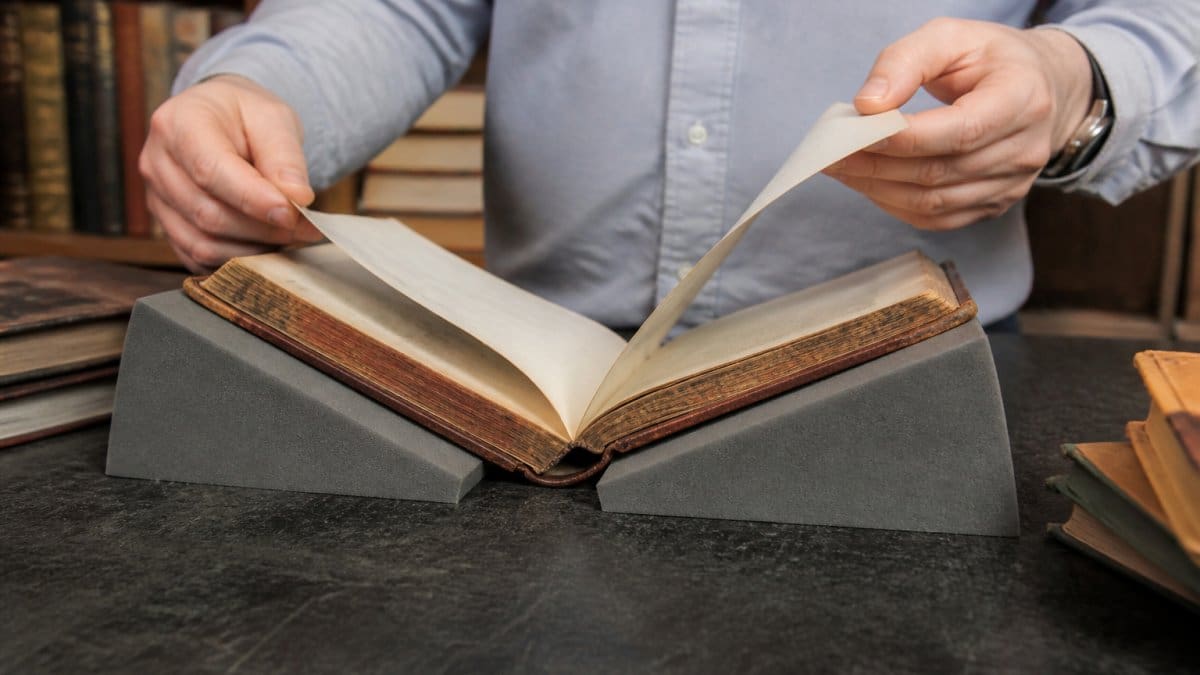
Handle old books with both hands. Never grab a book by its spine and pull.
Safe handling steps:
- Wash and dry your hands before touching rare books
- Use both hands, never one-handed grabs
- Support the spine from underneath when lifting
When displaying an open book, support it properly. Never let pages hang unsupported or bend backward.
Dust attracts pests. Use a soft brush to gently remove it from page edges and covers.
Using Archival Book Storage Boxes and Protective Enclosures
Archival-quality boxes are one of the best investments for valuable books: their acid-free materials don’t degrade or transfer damage to your books.
What makes a box archival-quality:
- Acid-free cardboard and tissue (won’t yellow or damage pages)
- Lignin-free materials (lignin causes deterioration)
- Proper pH balance (neutral, not acidic)
Store boxes upright, don’t stack them so high that weight compresses books at the bottom, and label each box so you know what’s inside without opening it repeatedly. For extremely valuable books, a conservator can create a custom box or clamshell case that holds the book safely while allowing you to view it, more costly, but maximum protection.
Additional protective measures:
- Use acid-free tissue paper between pages of fragile books
- Wrap books in acid-free paper before boxing
- Store boxes in climate-controlled areas, not basements or attics
Assessing Condition, Responding to Damage, and When to Seek Professional Help
Check your collection every 6-12 months for mold, pest damage, loose pages, cracked spines, or water stains. Learn how to assess your collection’s condition and understand its value. The goal isn’t to become a conservator, it’s to recognize what you can safely handle at home, what to isolate and monitor, and what requires a professional before further harm occurs.
A simple triage framework
Sort every issue into one of three buckets:
- Routine care, safe to do yourself. Dusting with a soft brush, improving storage, adjusting shelving, and isolating a book from the rest of the collection.
- Isolate and monitor, do not attempt repair. Active mold, pest evidence, water exposure, and failing bindings. Separate the book, control the environment, and get an assessment.
- Stop and call a conservator. Anything involving valuable editions, active mold on text pages, detached boards, or wet paper. Handling these yourself usually converts a treatable problem into a permanent one.
Safe cleaning boundaries
Gentle cleaning is fine; amateur repair is not. A soft brush or a vacuum with a screen over the nozzle can lift surface dust. Beyond that, the risks outweigh the benefits:
- Do not use household cleaners, bleach, alcohol, or erasers on paper or leather. They stain, bleach, or abrade original material.
- Do not use pressure-sensitive tape to repair tears. Tape adhesive migrates into paper, stains, and is extremely difficult to reverse.
- Do not glue loose pages or tighten a hinge with craft glue. Wrong adhesives and misalignment cause long-term damage harder to fix than the original problem.
Watch Out
If a repair requires disassembly, adhesive, or moisture, it is a conservator’s job. The most common costly mistake is a well-intentioned home repair that a professional then has to undo.
If a repair requires disassembly, adhesive, or moisture, it is a conservator’s job. The most common costly mistake is a well-intentioned home repair that a professional then has to undo.
Common damage and first response
Mold or mildew: Isolate the affected book immediately in a dry, ventilated space away from the collection.
Loose or torn pages: Stop handling the book. If pages are falling out, the binding is failing.
Water damage: Act fast but do not improvise.
Cracked spine or broken binding: This signals the book needs conservation work. Store it flat and supported until it can be assessed.
Track condition over time
For each book, record a short identifier, acquisition date, condition notes, a photo of the binding and any damage, plus the date of each inspection and any change. This log lets you spot slow deterioration, a loosening hinge, spreading foxing, before it becomes expensive, and documents condition if you insure, sell, or donate the book.
Disaster planning and recovery
- Keep books off the floor and away from pipes, and know where the nearest shutoff is.
- Have a written plan: who to call, which books are highest priority, and where they can be moved.
- After any water event, treat wet books as an emergency. Do not stack them, do not close them tightly if already wet, and do not wait to see whether they dry on their own.
When to call a professional
- Visible mold or pest damage
- Loose or detached pages or boards
- Broken or severely cracked spine
A conservator can assess damage and recommend treatment. For rare or valuable books, professional restoration is worth the cost; for common books with sentimental value, it may not be. Ask for a written assessment and treatment proposal before authorizing work.
For help identifying valuable editions in your collection, check out our guide on how to spot first edition books, which teaches you how to recognize editions worth extra protection.
Start Protecting Your Collection Today
Preserving antique book collections comes down to three fundamentals: stable storage conditions, proper support, and careful handling. Most damage, basements, overcrowded shelves, rough handling, is preventable.
Start with location: move books out of basements and attics into a climate-controlled room, add a hygrometer, use bookends and archival boxes for valuable volumes, and handle books with both hands.
If you have books you want to sell or trade, Greatest Hits Music & Books makes it easy. We also accept books for store credit if you’d rather explore our collection. Shop our collection to see what treasures we have in stock, or bring your books in for an evaluation.
Frequently Asked Questions
What temperature and humidity are best for storing old books?
Stable conditions are more important than specific numbers, but aim for 60-70°F and 30-40% relative humidity. Fluctuations cause paper and binding materials to expand and contract, leading to warping and damage. Avoid basements (high humidity and flood risk) and attics (temperature swings). A climate-controlled interior room works well. Monitor conditions with an inexpensive thermometer and hygrometer.
Should antique books be stored upright or flat?
Store most books upright on shelves, supported by bookends on both sides to prevent leaning and warping. Very large or heavy books should lay flat to avoid stress on the spine. Never stack books horizontally in tall piles. Upright storage with proper support distributes weight evenly, reduces rubbing between pages, and makes inspection easier.
How should you handle a fragile or damaged book?
Support the spine and binding with both hands when removing a book from the shelf. Open books slowly and never force the pages. Avoid touching text or illustrations with bare fingers. Wear cotton gloves when handling leather books or those with gilt edges. If a book shows loose pages, cracked leather, or mold, stop handling it and consult a professional book conservator before attempting repairs yourself.
Can you remove mold from an old book yourself?
Do not attempt to clean mold yourself, spores can spread to other books and harm your health. Place the affected book in a sealed container away from your collection. Contact a professional book conservator or conservation lab. They have proper equipment and fungicides to safely treat mold. Prevention is far easier: maintain humidity below 50%, ensure good air circulation, and inspect books regularly for early signs of mold or discoloration.
Protecting rare books doesn’t require perfection, it requires consistency. Keep temperature and humidity stable, store books upright with proper support, handle them gently, and inspect regularly for damage. Follow these practices and your antique book collection will survive and appreciate for years to come.
