

Sub-Total: $0.00
How to Spot First Edition Books: A Collector’s Guide
Table of Contents
- What Makes a Book a First Edition?
- The Copyright Page: Your First Clue
- First Edition Identification by Publisher
- The Title Page and Dust Jacket Matter
- How to Value Rare Books
- Rare Book Appraisal Tools and Resources
- Common Traps: Book Club Editions and Facsimiles
- Conclusion
- Frequently Asked Questions
Last Updated: October 2, 2026
What Makes a Book a First Edition?
A first edition is the first published version of a book, printed from the original typesetting before any changes were made. For collectors, that means the earliest copies carry details later printings don’t have.
First Edition vs. First Printing
A first edition is the first version of a book. The first printing is the first batch of copies run off the press.
What to remember:
- First edition = first version of the text
- First printing = first batch of copies
- First printing of the first edition = the most sought-after version
The Copyright Page: Your First Clue
The copyright page is where identification begins. It’s usually on the back of the title page, and it holds the details that separate a true first edition from a reprint.
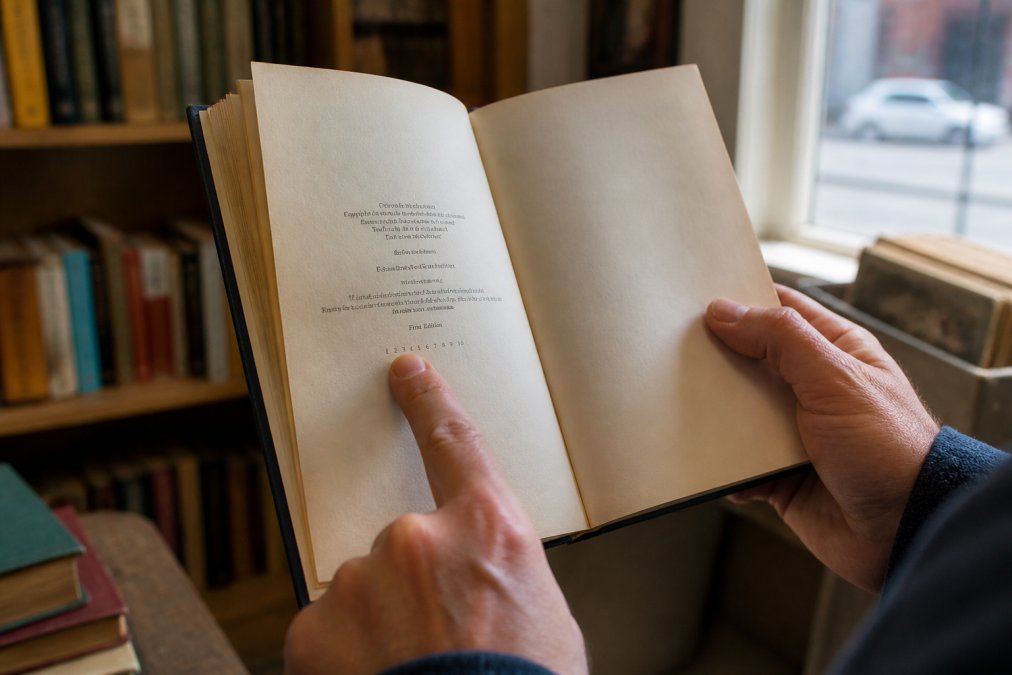
Look for these elements:
- Copyright date – The year the book was first published
- Number line – A row of numbers or letters that tells you the printing
- Edition statement – Phrases like “First Edition” or “First Printing”
- Publisher information – Names and imprints that changed over time
Reading the Number Line
The number line is a row of digits on the copyright page. It tells you which printing you’re holding.
Here’s how it works:
- A number line reading “10 9 8 7 6 5 4 3 2 1” means first printing
- A number line reading “10 9 8 7 6 5 4 3 2” means second printing
- Publishers remove the lowest number with each new printing
Pro Tip
Not every publisher uses number lines. Some older books and small presses skip them entirely. When there’s no number line, check the edition statement and copyright date instead.
Not every publisher uses number lines. Some older books and small presses skip them entirely. When there’s no number line, check the edition statement and copyright date instead.
First Edition Identification by Publisher
Publisher identification is where most guides get vague, and it’s where most collectors get burned. Every house has its own system, and the same phrase, “First Edition”, can mean different things depending on who printed the book and when.
Pre-ISBN Identification (Before ~1970)
Before the ISBN system standardized in the early 1970s, publishers used a patchwork of signals. There was no universal “first edition” statement, so collectors rely on points of issue, specific typographical details that were corrected between printings.
Common pre-ISBN patterns:
- Random House, States “First Edition” on the copyright page. Earlier titles sometimes used a stylized colophon on the title page or copyright page instead.
- Doubleday, Often states “First Edition” followed by a code. Doubleday also used a “Garden City, N.Y.” imprint line that appears on many firsts.
- Scribner, Frequently used a letter code on the copyright page (for example, “A-3.57[H]”), where the letter indicates the printing.
- Houghton Mifflin, Used a date line listing the year of each printing; the earliest year present indicates the printing.
- Viking, Often states “First published in [year]” with no mention of later printings on a true first.
ISBN-Era Identification (1970 to Present)
Once ISBNs became standard, publishers moved toward cleaner, more consistent signals. The number line became the dominant tool, and most major houses now print an explicit edition statement.
Modern patterns to check:
- Number line, A descending row of digits (e.g., “10 9 8 7 6 5 4 3 2 1”). The lowest number present indicates the printing. A full line ending in “1” is a first printing.
- Edition statement, Phrases like “First Edition,” “First Printing,” or “First American Edition” on the copyright page.
- Copyright date vs. printing date, A single copyright year with no later dates usually signals a first; multiple years signal reprints.
- ISBN and barcode, Present on modern books; the ISBN itself doesn’t tell you the printing, but the copyright page layout around it often does.
Small Presses and University Publishers
Pro Tip
When a publisher’s system is unclear, search for a published bibliography specific to that author or press. Bibliographies list the exact points of issue for known first editions, they are the closest thing to a definitive answer.
When a publisher’s system is unclear, search for a published bibliography specific to that author or press. Bibliographies list the exact points of issue for known first editions, they are the closest thing to a definitive answer.
The lesson: learn the patterns for the publishers you actually collect, and always check points of issue on pre-ISBN books. A generic checklist will miss the details that separate a true first from a later printing.
The Title Page and Dust Jacket Matter
The title page confirms what the copyright page suggests. It should list the title, author, and publisher. If the title page lists a different publisher than the copyright page, you may have a book club edition or a later reprint.
- Original price – Printed on the front flap
- First edition statements – Sometimes on the flap or back panel
- Correct issue points – Typographical details that changed between printings
Watch Out
A price-clipped dust jacket or one that says “Book Club Edition” signals a reprint. These copies typically sell for a fraction of true first edition prices.
A price-clipped dust jacket or one that says “Book Club Edition” signals a reprint. These copies typically sell for a fraction of true first edition prices.
How to Value Rare Books
How to value rare books comes down to a mix of factors. No single detail determines worth.
Key factors include:
- Condition – A fine copy can be worth many times a reading copy
- Scarcity – Fewer copies means higher demand
- Demand – Popular authors and subjects command more
- Significance – First books, prize winners, and cultural touchstones matter
- Provenance – Previous owners and inscriptions can add or subtract value
Condition grading uses standard terms:
| Grade | Description | Impact on Value |
|---|---|---|
| Fine | Nearly new, no flaws | Highest value |
| Near Fine | Minor wear, no major issues | Strong value |
| Very Good | Some wear, complete | Moderate value |
| Good | Noticeable wear, still intact | Lower value |
| Fair | Heavy wear, may have damage | Minimal value |
Rare Book Appraisal Tools and Resources
Rare book appraisal tools help you estimate value before seeking a professional opinion. These resources won’t replace an expert, but they give you a starting point.
Useful tools include:
- Bibliographic databases – Search completed sales for comparable copies
- Collector forums – Ask experienced collectors about specific titles
- Price guides – Published references for common collectible authors
- Auction archives – Records of what similar books sold for
Key Takeaway
Online asking prices are not the same as sold prices. Always check completed sales to get a realistic value range.
Online asking prices are not the same as sold prices. Always check completed sales to get a realistic value range.
Common Traps: Book Club Editions and Facsimiles
Book club editions are the single most common trap for new collectors. They look like first editions, they often carry the same copyright page, and they’re frequently sold online as firsts by sellers who either don’t know better or hope you don’t either.
Visual Cues That Separate Trade from Book Club
The differences are usually visible once you know where to look:
- Dust jacket statement, “Book Club Edition” printed on the front flap or back panel. Sometimes abbreviated as “BCE.”
- No price on the flap, Trade firsts almost always carry a printed price on the front flap. Book club jackets typically have no price, or a small code instead.
- Smaller trim size, Book club editions are often about 8 to 8.5 inches tall versus the 9 to 9.5 inches of the trade first. A ruler is a legitimate tool here.
- Different binding, Cheaper boards, plainer spines, or a different cloth color than the trade edition.
- Blind stamp on the back cover, A small indented mark, often a publisher logo or the words “Book Club Edition,” pressed into the rear board.
- Simplified copyright page, Often missing the number line entirely, or showing a single copyright year with no printing history.
Facsimiles: The Other Trap
Facsimiles are exact reproductions of original editions, printed years or decades later. They may reproduce the original copyright page faithfully, including the original date, which makes them genuinely deceptive at a glance.
The tell is usually elsewhere in the book:
- A recent publication date or “Reproduction” note on the copyright page or title page verso
- A modern ISBN and barcode on the back cover
- Publisher information that doesn’t match the original imprint
- Paper and binding that feel modern rather than period-appropriate
Watch Out
A facsimile can reproduce the original copyright page exactly. Never rely on the copyright date alone, check the publisher imprint, the ISBN, and the physical materials.
A facsimile can reproduce the original copyright page exactly. Never rely on the copyright date alone, check the publisher imprint, the ISBN, and the physical materials.
Why This Matters for Value
A book club edition of a sought-after title typically sells for a small fraction of the trade first edition price, often 5 to 15 percent, depending on the title. A facsimile is usually worth even less, since it has no collectible status at all.
Key Takeaway
If a deal looks too good for a known first edition, check for book club cues first. The price is usually the clue that something is off.
If a deal looks too good for a known first edition, check for book club cues first. The price is usually the clue that something is off.
Conclusion
Spotting first edition books takes practice and attention to detail. The copyright page, number line, and publisher patterns give you the clues. Condition and dust jacket details seal the verdict.
Shop Our Collection and see what’s waiting for you.
Frequently Asked Questions
How can I tell if a book is a first edition or not?
Check the copyright page for the words ‘First Edition’ or a number line that starts with ‘1.’ Look at the title page to confirm it matches the copyright page. Also examine the dust jacket for a price and the publisher’s name. If the book lacks these indicators, it may be a later printing or a book club edition. For publisher-specific methods, consult a guide like ‘First Edition Identification by Publisher.’
Is 10 9 8 7 6 5 4 3 2 1 a first edition?
Yes, a number line that includes ‘1’ (such as 10 9 8 7 6 5 4 3 2 1) indicates a first printing. If the ‘1’ is missing, it’s a later printing. Some publishers use a single ‘1’ or ‘First Edition’ instead. Always check the copyright page and title page together for confirmation.
Does a copyright date guarantee a first edition?
No, a copyright date alone does not guarantee a first edition. Many later printings share the same copyright date as the first edition. You must also check for a number line starting with ‘1,’ the phrase ‘First Edition,’ or other publisher-specific points of issue. Without these, the book could be a later printing or a book club edition.
What is the difference between a first edition and a first printing?
A first edition refers to the first set of copies printed from a specific setting of type, while a first printing is the first batch within that edition. A book can be a first edition but a later printing if additional copies were made from the same plates. Collectors often prioritize first printings because they are closest to the original release.