

Sub-Total: $0.00
How to Build a Home Library Cheaply: A Complete Guide
Last Updated: October 26, 2026
Quick Summary
You can build a home library cheaply by spending most of your budget on secondhand books from library sales, charity shops, and trade-in credit while saving on structure with plank-and-bracket or used shelving. A starter home library of about 100 books on 30 linear feet of shelving can cost roughly $105 to $210 using the low-cost approach. Measure your space and collection first, then anchor every shelf into wall studs to handle the weight.
- A 36-inch shelf holds roughly 28 to 36 hardcovers or about 45 paperbacks.
- Break your budget into four lines: books, shelving, hardware, and lighting.
- A 1-by-10 pine board spans about 30 to 36 inches safely between brackets.
- Space shelves 12 to 14 inches apart for standard books.
- Keep the heaviest books on the bottom shelves and check brackets twice a year.
Table of Contents
- Planning Your Home Library Space and Budget
- Where to Buy Used Books Without Overspending
- Finding Cheap Bookshelves for a Home Library
- Small Home Library Ideas for Tight Spaces
- How to Organize a Home Library That Looks Custom
- Renter-Friendly and No-Drill Library Solutions
- Start Your Collection With a Trip to Greatest Hits Music & Books
- Frequently Asked Questions
Planning Your Home Library Space and Budget
Building a home library cheaply starts with measuring before you buy a single book or shelf. The fix is simple: plan the room and the budget first, then shop.
Measure Your Space and Collection
Walk the room with a tape measure and note wall length, ceiling height, and floor space you can spare. Then count what you own. A standard hardcover runs about 6 by 9 inches, and a shelf depth of 10 to 12 inches fits nearly every trade book and most art books. Measure your tallest book before you commit to a shelf gap.
Do the shelf-length math before you shop. A typical trade hardcover takes about 1 to 1.25 inches of shelf width, and a mass-market paperback takes about 0.75 inch. That means a single 36-inch shelf holds roughly 28 to 36 hardcovers or about 45 paperbacks. A 6-foot wall run with five shelves gives you about 30 linear feet of shelf space, or roughly 300 to 360 hardcovers. Measure your current collection, add 20 percent for growth, and you have a target shelf length.
Set a Realistic Itemized Budget
A cheap home library is a series of small decisions, not one big purchase. We suggest writing your numbers down before you shop, because a browsing trip without a ceiling turns into a spending trip fast. Consumer Financial Protection Bureau budgeting tools offers free worksheets if you want a simple framework.
The table below shows realistic U.S. price ranges for a starter library of about 100 books on 30 linear feet of shelving. Treat the low column as the true budget build, the medium column as the comfortable build, and the higher column as the buy-it-once build.
| Budget Line | Low-Cost Approach (approx.) | Medium Approach (approx.) | Higher-Cost Approach (approx.) |
|---|---|---|---|
| Books (100 titles) | $50-$100 at library bag sales and swaps | $150-$250 mixed used and trade-in credit | $400-$800 new and collectible |
| Shelving (30 linear ft) | $40-$80 plank-and-bracket | $120-$250 used bookcases | $300-$700 ready-made units |
| Hardware | $15-$30 basic L-brackets and anchors | $40-$80 adjustable track | $100-$200 full track system |
| Lighting | $0 using existing lamps | $25-$60 clamp or floor lamp | $80-$200 wired shelf lighting |
| Total | $105-$210 | $335-$640 | $880-$1,900 |
These are planning ranges, not quotes; prices vary by region and season. The point is that a usable 100-book library is reachable for roughly the cost of a single new bookcase if you spend on books and save on structure.
Pro Tip
Photograph the wall and your book stacks before you shop. A phone photo with a tape measure in frame stops you from buying a bookcase that is an inch too tall or too deep.
Photograph the wall and your book stacks before you shop. A phone photo with a tape measure in frame stops you from buying a bookcase that is an inch too tall or too deep.
Where to Buy Used Books Without Overspending
The cheapest place to buy used books is usually a library sale, a charity shop, or a store that trades credit for your old titles. Prices at these sources stay low because the inventory arrives donated or traded rather than bought at retail. For more on why secondhand shopping pays off, see the benefits of buying used physical media. Start with the sources closest to you, then work outward. Readers who want to compare online alternatives to Half Price Books can find options for used books and more.
Library Sales, Book Swaps, and Trade-In Credit
Public library sales often clear donated stock at the lowest prices you will find anywhere, and many run bag-fill days at the end. Book swaps let you trade duplicates for titles you actually want. Trade-in credit is the quiet workhorse of a cheap library: you bring in books you have finished, and the store credits you toward the next stack. Selling used books for store credit explains how the process works. American Library Association resources on library book sales lists how many public libraries run ongoing sales.
Finding Cheap Bookshelves for a Home Library
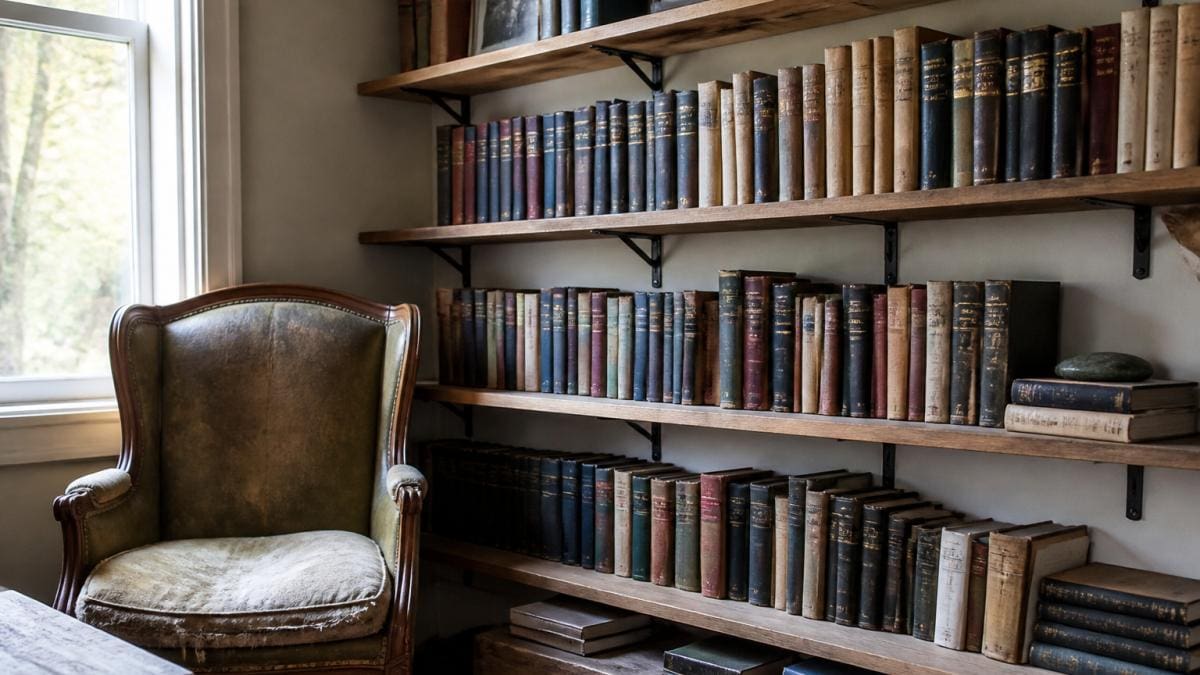
Cheap bookshelves for a home library come down to two paths: build simple plank-and-bracket shelves, or buy a used bookcase and reinforce it. Both beat new retail furniture on cost, and both let you match the shelf to the wall you actually have.
DIY Shelving With Planks, Brackets, and Bricks
The classic budget build is a plank on brackets, or a plank on bricks and boards. Buy straight, kiln-dried lumber and check each board for bowing before you take it home. A 1-by-10 or 1-by-12 pine board is the usual choice; a 1-by-10 spans about 30 to 36 inches safely between brackets, and a 1-by-12 can go a little wider. Space shelves 12 to 14 inches apart for standard books, and finish the wood with a coat of paint or stain so it reads as furniture rather than scrap. Bricks and boards need no drilling at all, which makes them the easiest option for a first build and the safest for renters.
Shelf Safety, Load Limits, and Anchoring
Books are heavy, and the math matters. A hardcover averages about 1.5 to 2 pounds, so a 36-inch shelf packed with 30 hardcovers carries roughly 45 to 60 pounds. A five-shelf unit can hold 225 to 300 pounds before you add the boards themselves. That is why every bracket should land in a wall stud wherever possible. Studs sit 16 or 24 inches on center in most U.S. homes; find them with a stud finder or by tapping, and mark them with painter’s tape before you drill.
When a stud is not where you need it, use rated anchors sized for the load, and never rely on plain drywall anchors alone for a loaded book shelf. Keep the heaviest books on the bottom shelves, distribute weight evenly across the span, and check brackets for loosening twice a year. A common pattern is to overload the top shelf because it is eye level; resist it.
Watch Out
Skipping the stud and relying on drywall anchors alone is the most common cause of a collapsed shelf, and it takes the books and the wall with it. If you cannot find a stud, use a freestanding or brick-and-board unit instead of a wall-mounted shelf.
Skipping the stud and relying on drywall anchors alone is the most common cause of a collapsed shelf, and it takes the books and the wall with it. If you cannot find a stud, use a freestanding or brick-and-board unit instead of a wall-mounted shelf.
Renter-Friendly and No-Drill Options
If your lease forbids drilling, you can still build a full library. Brick-and-board shelves, stacked crates, and tall freestanding bookcases all come down in an afternoon and leave no trace. Tension rods and adhesive strips handle light loads only, so keep them for paperbacks and decor, not hardcovers. Budget for a tall freestanding unit instead of brackets; it costs more up front but moves with you, which makes it cheaper over several moves. Anchor freestanding units to the wall with a removable strap if your lease allows, and keep the heaviest titles on the bottom to lower the center of gravity.
Small Home Library Ideas for Tight Spaces
Small home library ideas work best when you stop thinking of a library as a room and start treating it as a wall. A single tall shelf, a hallway run, or the space under a staircase can hold a real collection. Go vertical: a narrow bookcase that reaches near the ceiling stores far more than a wide, low unit. A reading nook with one armchair and a lamp turns a dead corner into the most-used spot in the house. Dark paint on the wall behind the shelves makes a modest collection look intentional, and it hides scuffs that light colors show.
How to Organize a Home Library That Looks Custom
A home library looks custom when the shelves fit the wall, the books sit forward, and the arrangement has a rhythm. Organize by subject or color, then leave a little breathing room on each shelf so the eye can rest. Mix upright books with a few stacked horizontally to break the row. Add one or two objects, a framed print or a small antique, and the shelf stops looking like storage.
Arranging Books Around the Home
You do not need a dedicated room to enjoy a personal library. Spread the collection: cookbooks in the kitchen, art books on the coffee table, fiction in the bedroom. Once everything is shelved, learn how to clean vintage book covers without damage so your finds stay presentable, and read up on how to preserve antique book collections if any of your titles are old or fragile.
Renter-Friendly and No-Drill Library Solutions
Renters can build a full library without putting a single hole in the wall. Free-standing bookcases, stacked crates, and brick-and-board shelves all come down in an afternoon and leave no trace. Tension rods and adhesive strips handle light loads only, so keep them for paperbacks and decor. If your lease forbids drilling, budget for a tall freestanding unit instead; it costs more than brackets but moves with you, which makes it cheaper over several moves.
Start Your Collection With a Trip to Greatest Hits Music & Books
The hardest part of a cheap home library is not the shelves. It is building a collection worth shelving, one title at a time, without overspending. That is where we come in. Greatest Hits Music & Books pays cash for books and offers store credit for your pre-loved books, music, movies, games, and figures, so you can turn a shelf you have outgrown into the next stack you actually want. Our selection runs from bestselling fiction to rare vintage finds, with vinyl, movies, and nostalgic collectibles mixed in. Curating specific genres adds a layer of intentionality to building book collections that helps you focus your budget on the stories you will revisit most often.
Get started with Greatest Hits Music & Books and turn your trade-ins into the first shelf of a library you will keep for years.
Frequently Asked Questions
How can I build a home library on a tight budget?
Start with a plan: measure your space, set a spending cap, and source books from library sales, book swaps, and trade-in credit at local shops. For shelving, DIY plank-and-bracket setups cost far less than retail bookcases. Build your collection gradually instead of buying in bulk, and prioritize sturdy, anchored shelves so your home library stays safe as it grows.
Where can I find cheap or free books for a home library?
Library book sales, charity bookshops, estate sales, and community book swaps are reliable low-cost sources. Many libraries also run freebie carts for withdrawn titles. Trading in books you no longer want for store credit at a local shop stretches your budget further. Ask about buyback programs before you haul boxes in, since condition and demand affect what gets accepted.
What is the cheapest way to store books at home?
Plank-and-bracket shelving on wall studs, stacked bricks with boards, and repurposed furniture like crates or ladder shelves are among the least expensive options. Renter-friendly picks include freestanding cube organizers and no-drill tension shelves. Whatever you choose, check the load rating and anchor tall units to the wall so a heavy book collection stays put.
How do I organize a small home library?
Use vertical space with tall shelves, tuck books under windows or along hallway walls, and mix in baskets for overflow. Group books by genre or color to create a custom look, and keep a small reading nook with an armchair or floor cushion. Rotate your display seasonally so the space feels fresh without adding furniture.
Are used books a good way to build a home library?
Yes. Used books cost a fraction of new retail prices and often include out-of-print titles you cannot buy new. Inspect spines, pages, and bindings before buying, and avoid heavily musty or water-damaged copies. Local shops that buy and trade pre-owned books give you a steady, affordable supply while keeping your collection rotating.
