

Sub-Total: $0.00
Where to Trade In Used Movies: Cash vs. Credit Guide
Last Updated: October 23, 2026
Quick Summary
You can trade in used movies at a local media store for same-day cash or store credit, through a mail-in buyback site for a per-item quote paid after inspection, or on an online marketplace for the highest per-title upside minus fees. Local stores pay less but pay now, while mail-in and marketplace sales take weeks and subtract shipping and fees.
- Call ahead to confirm the store is buying movies that week before you haul your discs in.
- Bring photo ID if you want cash and ask for both the cash and store credit offers.
- Blu-rays generally command higher offers than DVDs of the same title when scratch-free.
- A title selling for $10 on a marketplace nets closer to $6-$7 after fees and postage.
- Take cash for anything you won’t rebuy, credit if you shop regularly, and donate the rest.
Table of Contents
- Where to Trade In Used Movies: The Options Compared
- Where to Sell DVDs for Cash: Local Stores, Pawn Shops, and Buyback Sites
- How to Trade In DVDs and Blu-rays at a Local Media Store
- What Determines Used DVD Trade-In Value
- Cash, Store Credit, or Donation: Which Pays Off Most
- Condition, Packaging, and UPC Rules That Decide Your Offer
- What Happens to Movies a Store Declines
- Conclusion
- Frequently Asked Questions
Where to Trade In Used Movies: The Options Compared
Physical media never died. A Consumer Reports survey reported by Marketplace found that nearly half of respondents still watch DVDs and Blu-rays, and a surprising share still run VHS tapes. That stubborn demand is exactly why figuring out where to trade in used movies is worth your time. At Greatest Hits Music & Books, we buy and trade media, and we’ve watched sellers leave money on the table because they picked the wrong channel. Below, we compare the three real options, show what each pays, and explain how to get the best offer for your collection.
Used movie trade-in is the practice of exchanging DVDs, Blu-rays, and TV series box sets for cash or store credit at a local shop, a mail-in buyback service, or an online marketplace. The best channel depends on how much effort you’ll accept for the payout.
Quick Comparison: Local Store, Mail-In Buyback, and Online Marketplaces
| Option | Payout | Effort | Best For |
|---|---|---|---|
| Local media store | Cash or store credit, same day | Low: one trip | Fast, no shipping, instant answers |
| Mail-in buyback | Per-item quote, paid after inspection | Medium: pack and ship | Bulk collections, no local buyer |
| Online marketplace | Highest per-title upside, minus fees | High: photos, listings, shipping | Rare and in-demand titles |
| Pawn shop | Cash, usually lowest | Low | Emergency cash, single items |
| Donation | Tax deduction where eligible | Low | Declined or low-value discs |
Where to Sell DVDs for Cash: Local Stores, Pawn Shops, and Buyback Sites
Cash is the fastest path, but the channel you pick changes what you actually keep. The table below compares the four cash outlets on the two numbers that matter: what you get per disc and what it costs you in time, fees, and travel.
| Channel | Typical payout per common DVD | Fees or costs | Time to cash |
|---|---|---|---|
| Local media store | Cash offer quoted on the spot | None; one trip | Same day |
| Pawn shop | Lowest of the four; often a flat per-disc rate | None; one trip | Same day |
| Mail-in buyback site | Per-item quote, paid after inspection | You pay shipping unless the service provides a prepaid label | 1-3 weeks |
| Online marketplace | Highest per-title upside | Seller fees, shipping supplies, and postage come out of the sale price | Days to weeks |
Local media stores. A shop that buys pre-owned media can hand you cash or store credit on the spot, and you keep the discs it declines. Call ahead to confirm the store is buying that week, bring photo ID for cash, and ask for both the cash and credit figures before you commit. The cash number is usually lower than credit because the store is taking on resale risk.
Pawn shops. Pawn shops take movies but usually treat them as filler. Expect low offers, limited interest in TV series box sets, and a flat per-disc rate rather than title-by-title pricing. Use a pawn shop only for a single item when you need cash immediately and no media store is open.
Mail-in buyback sites. These services let you enter UPCs for an instant quote, then ship the accepted items. The quote is not final until inspection, and the service may revise it downward for scratches, missing artwork, or edition mismatches. Comparison services such as Bonavendi check multiple buyers at once, which helps when you’re selling a large lot and want to see which service quotes highest for each title.
Online marketplaces. Peer-to-peer sales carry the highest per-title upside but the lowest net after fees, shipping, and your time. A common pattern is that a title selling for $10 on a marketplace nets closer to $6-$7 after seller fees and postage, and that assumes the buyer pays shipping. Rare and in-demand titles justify the effort; common discs do not.
Key Takeaway
The trade-off is simple: speed and certainty versus per-title price. Local stores and pawn shops pay less but pay now. Mail-in buyback and marketplaces pay more per title but take weeks and subtract fees, shipping, and travel from the headline number.
The trade-off is simple: speed and certainty versus per-title price. Local stores and pawn shops pay less but pay now. Mail-in buyback and marketplaces pay more per title but take weeks and subtract fees, shipping, and travel from the headline number.
Before you choose a channel, sort your collection into three piles: titles worth listing individually, titles worth bulk-selling, and titles a store will likely decline. That sort, not the channel, determines most of your final payout.
How to Trade In DVDs and Blu-rays at a Local Media Store
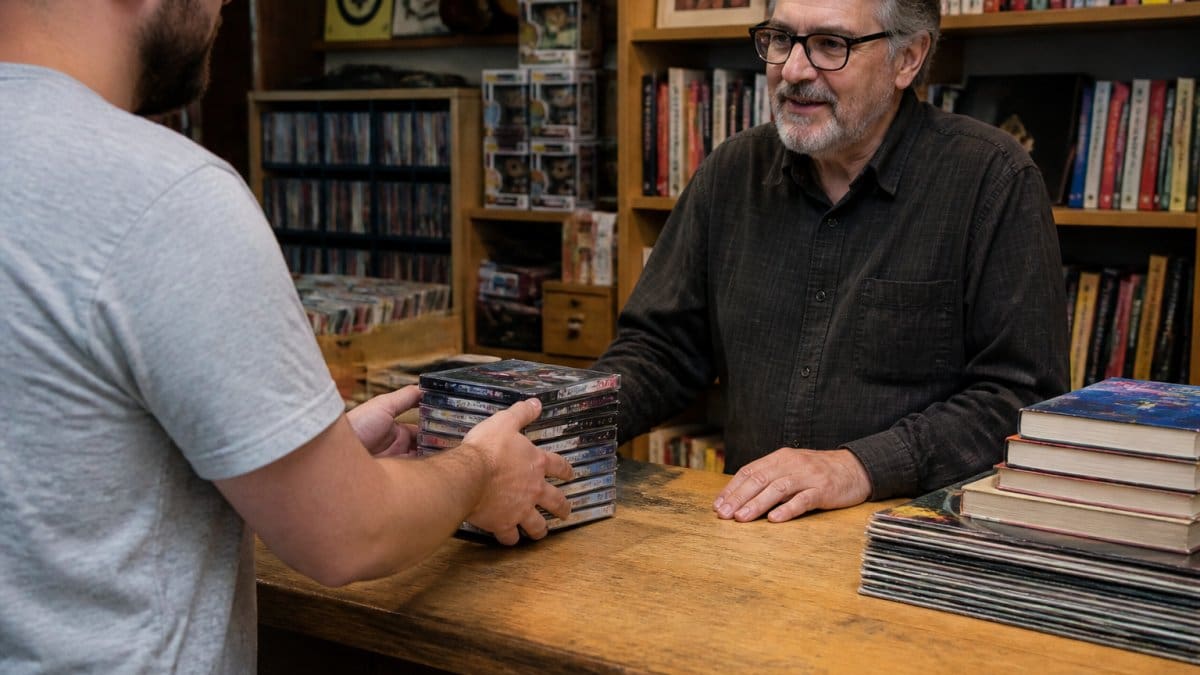
Bring your discs in cases, sorted and clean, and ask for a quote before you commit. Here’s the process, plus the eligibility checklist that decides whether a store will accept each item.
The walkthrough:
- Call ahead and confirm the store is buying movies that week. Buyback schedules change with inventory.
- Sort DVDs, Blu-rays, and box sets separately; pull out anything scratched or missing artwork.
- Bring photo ID if you want cash.
- Ask for two numbers: the cash offer and the store credit offer.
- Decide on the spot, and take home anything declined.
Eligibility checklist by format. Condition standards are strict, and they decide whether you get paid at all. Use this checklist before you leave the house:
- Discs: Free of deep scratches and able to play without skipping. Wipe fingerprints with a soft cloth. A disc that skips is usually declined outright.
- Cases: Must close and hold the disc securely. Replace broken cases when you can; don’t tape cracked cases shut.
- Artwork and inserts: Original cover art should be present. Missing inserts, rental stickers, and library markings all reduce offers.
- Box sets: Every disc must be included. A set missing one season is usually declined or heavily discounted.
- UPC or barcode: Must match the edition you’re selling. Buyers use it to confirm the exact release, and a mismatched UPC gets flagged during inspection.
- DVD versus Blu-ray: Blu-rays generally command higher offers than DVDs of the same title, but only if the disc is scratch-free and the case is intact. Stores vary on whether they accept HD DVD, 4K Ultra HD, or region-locked imports, ask before you haul them in.
Pro Tip
Ask whether the store pays more in credit than cash. Many shops do, and if you plan to buy anyway, credit usually stretches further than the cash figure.
Ask whether the store pays more in credit than cash. Many shops do, and if you plan to buy anyway, credit usually stretches further than the cash figure.
Watch Out
Don’t tape cracked cases shut or swap discs into the wrong case. Mismatched packaging and UPCs get flagged during inspection, and the whole lot may be declined.
Don’t tape cracked cases shut or swap discs into the wrong case. Mismatched packaging and UPCs get flagged during inspection, and the whole lot may be declined.
A common pattern is that sellers who sort and clean before arriving get a faster quote and a higher acceptance rate. If a store declines an item, ask why, the answer tells you whether to fix the packaging or stop trying.
What Determines Used DVD Trade-In Value
Used DVD trade-in value comes down to demand, condition, and completeness, not age. A sealed new release can be worth more than a rare classic in a cracked case. Stores weigh four things: whether the title still sells, whether the disc plays without skipping, whether the case and artwork are intact, and whether the UPC matches the edition. Box sets and complete TV series often carry more value than single discs because buyers want the full run. Documentaries, cult classics, and out-of-print Blu-rays can surprise you. Common titles from the DVD boom years usually earn little, because everyone already owns them.
Cash, Store Credit, or Donation: Which Pays Off Most
Cash wins when you want money out. Store credit wins when you’ll spend it, since shops often pay a higher credit figure than the cash offer. Donation wins when the alternative is a landfill: discs a store declines still have life at a library sale or charity shop, and you may be able to claim a deduction if you itemize. Our rule of thumb: take cash for anything you won’t rebuy, take credit for collectors who shop regularly, and donate the rest rather than hauling it home twice.
Condition, Packaging, and UPC Rules That Decide Your Offer
Condition standards are strict, and they decide whether you get paid at all. Discs should be free of deep scratches and play cleanly. Cases should close, artwork should be present, and box sets should include every disc. The UPC or barcode must match the edition you’re selling, since buyers use it to confirm the exact release. Missing inserts, rental stickers, and library markings all reduce offers. If a disc skips, most buyers pass entirely. Wipe fingerprints with a soft cloth, replace broken cases when you can, and keep sets together.
What Happens to Movies a Store Declines
Declined movies aren’t worthless, they’re just not worth buying that day. A store passes on titles it can’t resell quickly, on damaged discs, and on duplicates already in inventory. You have three moves: try a second buyer, list the title yourself online, or donate it. Some sellers bundle declined discs into a single marketplace lot, which moves inventory faster than listing each title. Ask the buyer why an item was declined; the answer tells you whether to fix the packaging or stop trying. Nothing should go in the trash while a charity shop will take it.
Conclusion
Sorting a collection is the easy part. The hard part is deciding which channel actually pays you best for the effort. Bring your DVDs, Blu-rays, and box sets to Greatest Hits Music & Books, where we buy pre-owned media for cash and offer store credit, alongside our shelves of records, books, games, and nostalgic finds. You’ll get a straight answer on the spot and keep anything we pass on. Shop our collection and see what your old movies can become.
Frequently Asked Questions
Where is the best place to sell DVDs for cash?
Local independent media stores and pawn shops pay cash on the spot, while mail-in buyback services send payment after they inspect your discs. Local stores let you ask questions and walk out with money the same day. If you want cash without shipping, call ahead to confirm the store buys used movies and ask what condition they require. For trade in used movies, an in-person store also lets you see what else is on the shelf before you spend your payout.
Are DVDs making a comeback?
Physical media still has a loyal audience. A Consumer Reports survey reported by Marketplace in February 2026 found nearly half of respondents still watch DVDs and Blu-rays, and 15% still watch VHS tapes. Circana’s 2026 year-to-date sales ranking also shows new releases selling on disc, with titles like Avatar: Fire and Ash and Wicked: For Good in the top three. That steady demand is why stores and buyback services still make offers on used movies and TV series.
Do bookstores buy used movies, or only books?
It depends on the store. Some independent book and media shops carry used movies alongside books, vinyl, and games, and they may offer cash or store credit for pre-loved media. Others stick to books only. Call before you haul in boxes and ask three things: which formats they accept, whether they pay cash or credit, and whether they require original cases and artwork. That one call saves a wasted trip and tells you where to trade in used movies near you.
Can I get cash or store credit for used movies, and which is better?
Most stores that buy used media offer both, and store credit usually comes out higher than a cash payout on the same stack. Take the credit if you plan to buy more movies, records, or books, because the extra value stays in your collection. Take the cash if you are clearing space and do not need anything in return. Ask for both numbers before you commit, then compare the used DVD trade-in value against what you would actually spend.
