

Sub-Total: $0.00
Best Places to Sell Vinyl Records Locally in 2026
Table of Contents
- Why Selling Vinyl Records Locally Beats Shipping Them
- Local Record Stores That Buy Records: What to Expect
- How to Value Vinyl Records Before You Sell
- Should You Sell a Vinyl Record Collection as a Whole or Piece by Piece?
- Where to Sell Vinyl Records for Cash: Stores, Fairs, and Online Marketplaces
- How to Find a Reputable Local Buyer Without Getting Lowballed
- Frequently Asked Questions
Last Updated: October 12, 2026
Why Selling Vinyl Records Locally Beats Shipping Them
This guide covers how local buyers work, how offers get calculated, and how to value your records before you walk in the door.
The math is simple. Selling online means photographing each record, grading it, packing it, and paying seller fees.
Many sellers find that a local sale nets a comparable payout once fees and shipping come out of an online listing.
Below, we’ll show you exactly how to prepare, price, and place your records so you get a fair offer the first time.
Local Record Stores That Buy Records: What to Expect
A local record store is the fastest route to cash. You bring your records in, a buyer inspects them, and you get an offer the same day.
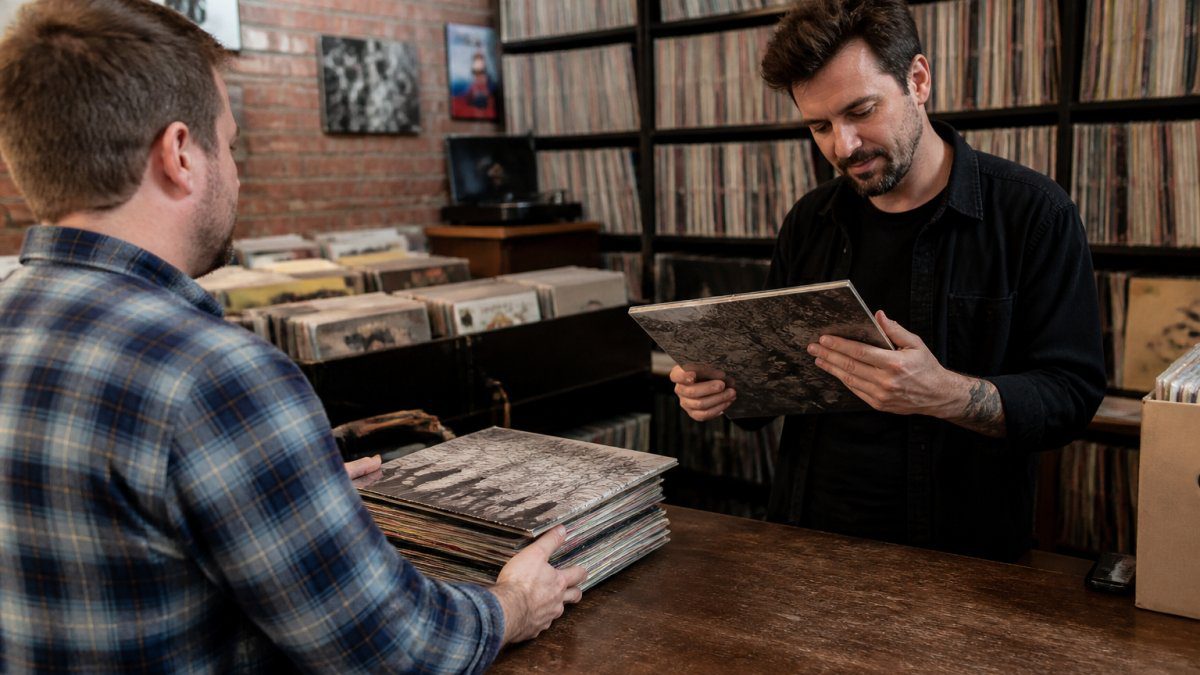
Expect the buyer to flip through your stack quickly, pull out anything they want, and set the rest aside. Most shops buy to resell, so they’re looking for titles their customers actually want.
How Store Offers Are Calculated
A store offer reflects what the shop can resell the record for, minus its margin and the risk it sits on the shelf. That’s why an offer often lands well below the online asking price.
Buyers weigh four things: condition, demand, how much of that title they already have in inventory, and how fast it typically sells. A common mistake is assuming a rare record always means a big offer.
Watch Out
Bringing in a whole collection at once often gets you a lower per-record offer than bringing in a curated stack. Shops price bulk on the assumption that most of it won’t move.
Bringing in a whole collection at once often gets you a lower per-record offer than bringing in a curated stack. Shops price bulk on the assumption that most of it won’t move.
Cash vs. Trade Credit: Which Pays More
Store credit usually comes in higher than a cash offer. That’s standard across the trade-in model, because credit keeps the value inside the shop.
If you’re a regular buyer, credit stretches further. If you want money out, take the cash. Neither is wrong; it depends on whether you plan to buy more records.
How to Value Vinyl Records Before You Sell
Valuing a record means checking three things: the pressing, the condition, and recent sold prices for that exact version. Skip any one and you’ll misjudge the offer.
Start with the pressing. Two copies of the same album can differ wildly in value depending on the year, the label, and the catalog number printed on the spine and label.
Then check condition using the standard Goldmine grading scale, which runs from Mint down to Poor. The Goldmine grading standards overview is the reference most buyers use, so learn the terms before you walk in.
Finally, look up recent sold prices, not asking prices. Anyone can list a record high; what matters is what buyers actually paid.
Grading Condition and Identifying Pressings
Grade honestly. A record you call Very Good that a buyer grades Good drops your whole stack’s credibility.
Check the vinyl under bright light for scratches and scuffs. Check the sleeve separately, since sleeve condition and record condition are graded apart.
For the pressing, look at the matrix number etched in the runout groove and the label design. Both identify the exact version.
Pro Tip
Photograph the runout groove and label before you go. If a buyer questions your pressing, you have proof in your pocket, and it speeds up the whole transaction.
Photograph the runout groove and label before you go. If a buyer questions your pressing, you have proof in your pocket, and it speeds up the whole transaction.
Should You Sell a Vinyl Record Collection as a Whole or Piece by Piece?
Selling as a whole is faster and simpler. Selling piece by piece earns more per record but takes weeks of effort.
A whole-collection sale means one transaction, one payout, and a cleared shelf. You accept a bulk discount in exchange for the convenience.
Piece-by-piece selling means listing, grading, packing, and shipping individual records. You keep more of the value, but you become a small business for a few months.
When Breaking Up a Collection Makes Sense
Break up the collection when you have high-demand titles mixed in with common ones. Pull the valuable records, sell those individually or to a specialist buyer, and sell the rest as a lot.
If your collection is mostly common pressings, breaking it up rarely pays. The effort per record outweighs the extra dollars.
| Collection Size | Best Approach | Why |
|---|---|---|
| A few dozen records | Sell as a lot | Effort per record is too high otherwise |
| A few hundred, mixed | Split the highlights out | Captures value on the rare titles |
| Thousands, mostly common | Sell in bulk | Individual listing won’t pay off |
| Rare or sealed titles | Sell individually | Buyers pay a premium for these |
Where to Sell Vinyl Records for Cash: Stores, Fairs, and Online Marketplaces
Cash options fall into three buckets: local stores, record fairs, and online marketplaces. Each pays differently, asks something different of you, and carries a different level of risk.
Local record stores pay immediately and take everything you bring through the door in one visit.
Record fairs and pop-up buying events bring multiple buyers to one room. You can walk the floor and get more than one offer in an afternoon.
Online marketplaces like Discogs, eBay, Facebook Marketplace, and Craigslist reach more buyers, but you handle the listing, packing, and shipping. A Federal Trade Commission guide to online shopping and selling is worth reading before you list, since seller protections vary by platform.
How the Three Channels Compare
| Channel | Typical Payout | Time to Cash | Effort | Risk |
|---|---|---|---|---|
| Local record store | Below retail, reflects resale margin | Same day | Low, one visit | Low |
| Record fair / buying event | Varies by buyer, often between store and online | Same day at event | Medium, transport and wait | Low to medium |
| Online marketplace | Highest gross, minus fees and shipping | Days to weeks | High, list, pack, ship | Medium to high (returns, disputes) |
Record Fairs and Pop-Up Buying Events
Record fairs are the middle ground between a store and an online listing. You get in-person buyers and a chance to compare offers without shipping anything.
Check local event listings and shop bulletin boards for upcoming fairs. Bring your records graded and priced, and arrive early, since the best buyers work the room first. A few practical notes:
- Bring a portable price list for your higher-value titles so you can quote a number without guessing.
- Accept cash only from buyers you don’t know, and count it before they walk away.
- Don’t leave records unattended on a table or in a car between offers.
Payment Methods and What to Accept
- Cash is final and the safest option for in-person sales. Count it before the handoff.
- Peer-to-peer payment apps are convenient but can be reversed or disputed. For large amounts, prefer cash or a verified bank transfer.
- Personal checks should be avoided for one-off sales. If you accept one, wait for it to clear before releasing the records.
When Each Channel Wins
- You want cash today and minimal effort: local record store.
- You have valuable titles and want competition between buyers: record fair or buying event.
- You want the highest gross price and can wait: online marketplace.
Key Takeaway
For most sellers, a local record store wins on speed and simplicity, record fairs win on competition between buyers, and online marketplaces win on price if you’re willing to do the work. Pick the channel that matches what you actually want, cash now, or more money later.
For most sellers, a local record store wins on speed and simplicity, record fairs win on competition between buyers, and online marketplaces win on price if you’re willing to do the work. Pick the channel that matches what you actually want, cash now, or more money later.
How to Find a Reputable Local Buyer Without Getting Lowballed
Most guides tell you to “find a reputable buyer” and stop there. That’s not a method, it’s a wish. Here’s a repeatable process you can run in any market, whether you’re in a major metro or a small town with one shop.
Step 1: Build a buyer list before you contact anyone
Search for shops that advertise buying used vinyl, then widen the net with these terms:
- “we buy vinyl” plus your metro area
- “used records bought” plus your state
- “record collection buyer” plus “cash”
Aim for three to five names. One buyer is not a market; it’s a take-it-or-leave-it offer.
Step 2: Screen each buyer with three questions
Call or email before you haul anything in. The answers tell you more than any review:
- “How do you calculate your offer?” A real buyer will mention condition, demand, and their current inventory. A vague answer (“we just make an offer”) is a red flag.
- “What happens to records you pass on?” Good buyers hand them back or offer to donate with your permission. Buyers who keep everything they touch are pricing in a freebie.
- “Is the payout cash or credit, and what’s the difference?” Get the spread in numbers, not adjectives. Store credit commonly runs higher than cash because the value stays in the shop.
Step 3: Compare at least two offers on anything valuable
For a single high-value record or a collection worth several hundred dollars, get two offers before you commit. Offers can vary widely between shops because each one prices against its own customer base and shelf space. A shop that specializes in jazz may pay more for Blue Note pressings than a general shop that mostly moves rock.
Step 4: Verify the buyer’s track record
- Check the shop’s business registration with your state’s secretary of state or department of revenue if you’re selling a large collection.
- Look for a physical storefront with posted hours. Pop-up buyers with no fixed address are harder to hold accountable.
- Read recent reviews specifically for words like “fair,” “explained,” and “walked me through it”, not just star ratings.
Step 5: Protect yourself at the transaction
- Get the offer in writing for any collection over a few hundred dollars, including what’s included and the payout amount.
- Count the cash before you leave the counter. For large amounts, ask for a receipt or a signed itemized list.
- For private meetups, choose a public place during business hours. Many police departments offer designated safe-exchange zones, call your local non-emergency line to ask.
Watch Out
Watch for buyers who refuse to explain their pricing, push you to accept on the spot, or want to take records “on consignment” with no written terms. A fair buyer will let you think it over, especially on a large collection.
Watch for buyers who refuse to explain their pricing, push you to accept on the spot, or want to take records “on consignment” with no written terms. A fair buyer will let you think it over, especially on a large collection.
A quick reality check on “lowball” offers
A store offer that looks low usually isn’t an insult, it reflects resale margin, shelf risk, and demand. If you want top dollar, you’re selling to an end buyer, not a reseller. If you want speed and certainty, you’re selling to a reseller. Knowing which you want before you walk in prevents most of the frustration sellers describe.
Key Takeaway
The best protection against a lowball offer isn’t a single trusted shop, it’s having two or three screened buyers and knowing what your records are worth before you walk in.
The best protection against a lowball offer isn’t a single trusted shop, it’s having two or three screened buyers and knowing what your records are worth before you walk in.
Frequently Asked Questions
Where can I sell my vinyl records for cash?
Local record stores that buy records are the fastest route to cash. You walk in, staff inspect your albums, and you leave with payment the same day. Record fairs and pop-up buying events also pay cash on the spot. Online marketplaces like Discogs and eBay can yield higher per-record prices, but you handle listing, packaging, and shipping, and payout takes longer. For a quick sale with no shipping hassle, a local store is the most direct option.
How do I find out what my vinyl records are worth before selling?
Check recent sold prices on marketplace platforms, then factor in condition and pressing. A first pressing in near-mint condition commands far more than a later reissue with ring wear. Grade each record honestly using standard visual grading, note whether the sleeve and inner sleeve are original, and look up the matrix number in the dead wax to confirm the pressing. This prep work helps you recognize a fair offer when you hear one.
Do local record stores buy used vinyl records in poor condition?
Most stores buy records in good condition but pass on items with deep scratches, warping, water damage, or missing sleeves. Some shops accept lower-grade records for a bargain bin at a reduced offer. If your collection includes a mix of conditions, call ahead and ask about their buying criteria. Sorting your records into clean and questionable piles before you visit saves time and sets realistic expectations.
Should I sell my vinyl records individually or as a collection?
Selling individually through online marketplaces typically brings the highest total payout, but it takes weeks or months of listing, packing, and shipping. Selling a vinyl record collection as a whole to a local store is faster and simpler, though the per-record price is lower because the buyer assumes the risk of unsold inventory. If you want speed and convenience, a bulk sale wins. If you have rare titles and patience, piece-by-piece selling pays more.
What should I do to prepare my records before bringing them to a buyer?
Clean each record with a carbon-fiber brush or record cleaning solution, replace torn inner sleeves, and group titles by genre or artist. Remove any records you want to keep so there is no confusion at the counter. Bring a written inventory list with artist, title, and condition notes. Packing records upright in a sturdy box prevents warping during transport. A well-organized collection signals to the buyer that you know what you have.