

Sub-Total: $0.00
How to Trade In Old Video Games: A 2026 Guide
Table of Contents
- Why Trade In Old Video Games Instead of Letting Them Collect Dust
- How to Check the Value of Old Video Games Before You Trade
- Step 1: Grade Your Games and Consoles Before the Trade
- Step 2: Protect Your Data on Consoles and Handhelds
- Step 3: Compare Trade-In, Private Sale, and Online Buyback
- Step 4: Where to Sell Used Video Games for the Best Return
- Trade In Video Games for Store Credit: Is It Worth More Than Cash?
- Selling Video Games Locally: What to Expect at the Counter
- Frequently Asked Questions
Last Updated: October 14, 2026
Why Trade In Old Video Games Instead of Letting Them Collect Dust
Learning how to trade in old video games turns a shelf of forgotten discs into cash or store credit you can actually use.
Physical media still moves.
So here’s what most people get wrong: they haul a box to the first buyer they find and take the first number offered.
Below, we’ll show you exactly how to check value, grade your games, and compare your selling options before you commit.
How to Check the Value of Old Video Games Before You Trade
Checking value before you trade is the single step that separates a fair deal from a lowball offer. Most games are worth little, but a handful carry real money, and you won’t know which is which without looking them up.
Start with the exact title, platform, and region. A game on one console can be common while the same title on another is scarce.
A Repeatable Method for Estimating Fair Market Value
Most guides tell you to “check prices” and stop there. Here is a framework you can run on any game in about five minutes.
- Identify the exact item. Title, platform, region code, and edition. “Greatest Hits,” “Player’s Choice,” and “Nintendo Selects” reprints are usually worth less than the original print run.
- Pull recent sold prices, not asking prices. Filter completed or sold listings on a major marketplace and look at the last three to five sales from the past 30 to 90 days. Asking prices are wishes; sold prices are facts.
- Discard the outliers. One sealed copy selling high or one damaged copy selling low will skew your average. Throw out the top and bottom sale and average the middle.
- Adjust for condition. A common rule of thumb is that a complete copy (case, manual, disc or cartridge) sells for noticeably more than a loose copy, and a sealed copy can sell for multiples of an opened one. Deduct for scratches, missing manuals, sun-faded labels, and cracked cases.
- Subtract your costs. Private sales carry fees, shipping, and your time. A $40 sale on a marketplace that takes a cut and charges you to ship is not $40 in your pocket.
- Compare that net number to the cash and credit offers. Whichever route leaves you with the most after costs and effort is the right one for that item.
A store database or published price list gives you a baseline. Live market data tells you what’s moving right now. When the two disagree, trust the sold listings.
Spotting Retro, Sealed, and Collectible Games
Some games are worth far more than the rest, and they usually share a few traits. Learn to spot them before you trade anything away.
- Retro games from older consoles like Atari, Nintendo, and Sega often hold value, especially first-party titles and RPGs
- Sealed games in original shrink wrap can be worth many times an opened copy, but only if the seal is factory-original
- Collectible games with limited runs, low print numbers, or special editions draw steady demand
Pro Tip
Check the back of the case for a region code before you trade. Import games and regional variants often sell for more than the standard release, and a buyer who knows the difference will pay for it.
Check the back of the case for a region code before you trade. Import games and regional variants often sell for more than the standard release, and a buyer who knows the difference will pay for it.
eBay’s guide to sold listings and completed items
Step 1: Grade Your Games and Consoles Before the Trade
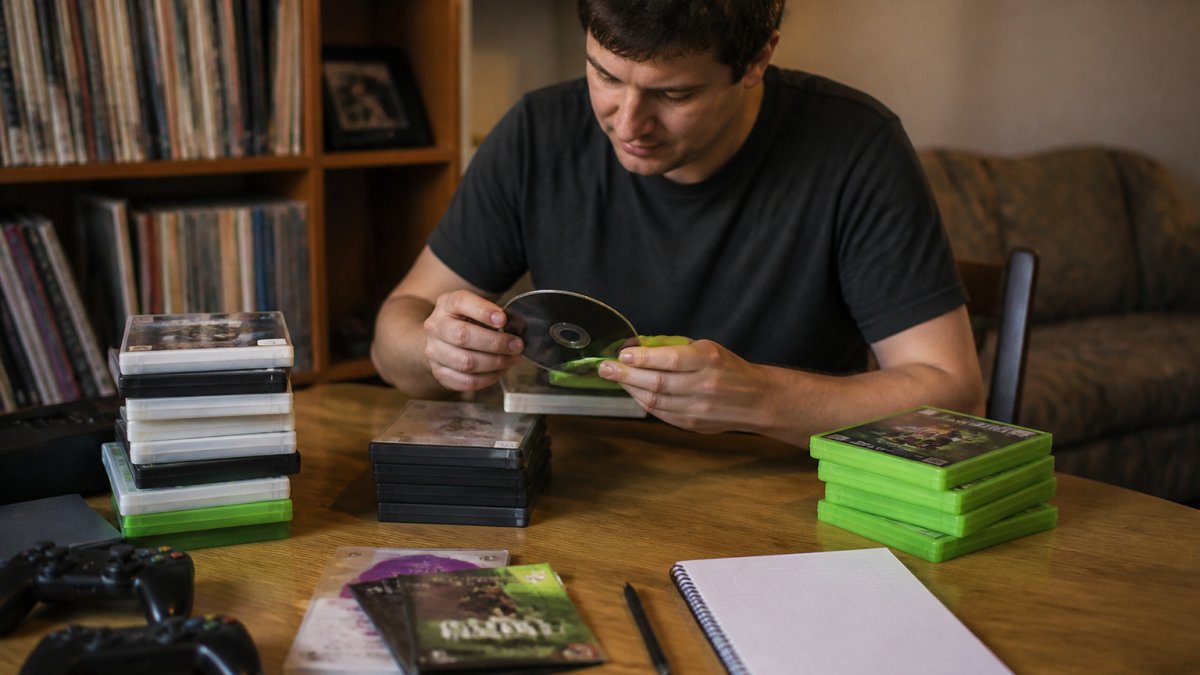
Grading your games before the trade means honestly sorting each item by condition, because condition drives the offer. Buyers pay more for clean, complete copies and less for scratched discs or missing manuals.
Set everything on a table and work through it item by item. A notepad helps you track what’s complete and what isn’t.
Condition Checklist: Cases, Manuals, and Discs
Run every game through the same checklist so you catch problems before a buyer does. This also helps you set realistic expectations.
- Case intact, with no cracks or heavy scuffs
- Original cover art present and not water damaged
- Manual included, if the game originally shipped with one
- Disc free of deep scratches and able to play
Games missing a manual or case still sell, just for less. Note the gaps so you aren’t surprised at the counter.
Step 2: Protect Your Data on Consoles and Handhelds
Wiping your data before you trade a console is not optional. Consoles and handhelds store account logins, saved payment info, personal profiles, and sometimes your real name and address. A new owner could access all of it if you skip this step.
The order matters. Back up what you want to keep first, then deactivate and unlink, then reset. If you reset before you back up, your saves are gone.
Back Up Saves and Purchases First
- Cloud saves: If you pay for an online subscription on a modern console, most saves sync automatically. Confirm the latest save uploaded before you wipe.
- Local backup: Copy saves to a USB drive or external storage if the console supports it.
- Physical media: Remove game cards, SD cards, memory cards, and any disc you’re keeping. These often hold saves and account data.
- Purchase history: Note which digital games you own so you can re-download them on a new console tied to the same account.
Deactivate and Unlink Accounts
A factory reset alone does not always release your account from the hardware. On most modern consoles, you should:
- Sign out of your account on the console.
- Deactivate the console as your “primary” or “home” device so your digital library and subscriptions aren’t tied to hardware you no longer own.
- Unlink any linked accounts (social, streaming, or store accounts).
- Remove saved payment methods and linked cards from the account itself, not just the console.
- Delete user profiles and saved game data.
- Perform a full factory reset from the system settings menu.
What to Remove Before You Hand It Over
- Memory cards, SD cards, and proprietary storage units
- Game cartridges and discs you’re keeping
- Controller cables, chargers, and accessories you want to keep
- Any printed account recovery codes or notes tucked in the box
Watch Out
Skipping the deactivation step can leave your account and payment details tied to a device you no longer own, and a factory reset does not always break that link. Take the extra five minutes to wipe it completely and deactivate it from your account settings.
Skipping the deactivation step can leave your account and payment details tied to a device you no longer own, and a factory reset does not always break that link. Take the extra five minutes to wipe it completely and deactivate it from your account settings.
If you’re trading a handheld, check whether the save data lives on the cartridge rather than the system. Some older handheld games store saves on the cart itself, which means trading the game trades your progress with it.
Step 3: Compare Trade-In, Private Sale, and Online Buyback
Comparing your three main options before you commit saves you from leaving money on the table. Each route trades speed for payout in a different way.
Here’s how the three stack up:
| Route | Speed | Typical Payout | Effort | Best For |
|---|---|---|---|---|
| In-store trade-in | Same day | Cash or store credit | Low | Quick, simple deals |
| Private sale | Days to weeks | Highest | High | Rare or high-value titles |
| Online buyback | About a week | Middle | Medium | Bulk lots you ship out |
In-store trade-ins are the fastest. Private sales often pay the most, but you handle photos, messages, and shipping. Online buyback sits in the middle and works well for large lots.
Step 4: Where to Sell Used Video Games for the Best Return
Where to sell used video games comes down to how much effort you want to spend versus how much you want back. Local stores and online buyers each fit different situations.
Local Game Store Trade-Ins
A local game store trade-in is the simplest path. You bring your items, get an offer, and walk out with cash or credit the same day. No shipping, no waiting on strangers.
Greatest Hits Music & Books buys games and consoles right at the counter, alongside books, records, and movies. You can trade in old video games for cash or take store credit toward something new.
Online Buyers and Prepaid Shipping Labels
Online buyers accept trade-ins by mail, usually with a prepaid shipping label. You box your items, drop them off, and get paid once they’re checked in.
The trade-off is time and risk. A USPS label makes shipping easy, but items can get lost or arrive damaged. Insure anything valuable and keep your tracking number.
- Print the prepaid shipping label before you box
- Pack discs and cartridges so they can’t shift
- Insure high-value shipments
- Save tracking and photos until payment clears
Trade In Video Games for Store Credit: Is It Worth More Than Cash?
Store credit usually beats cash at most trade-in counters, often by a meaningful margin.
So the real question is whether you’ll use the credit. If you plan to buy more games, records, or books, credit stretches further.
- Take store credit when you’ll shop again soon
- Take cash when you want flexibility or don’t visit often
- Ask for both numbers before you decide
At Greatest Hits Music & Books, we offer store credit for books, music, movies, games, and figures, so a trade can turn straight into your next find.
Selling Video Games Locally: What to Expect at the Counter
Selling video games locally is a quick, face-to-face deal, and knowing the process keeps it smooth. Bring your graded items, expect a quick review, and get an offer on the spot.
Most stores check condition, confirm the game plays, and look up current demand. Rare or sealed items may get a closer look.
- Bring your item list so nothing gets lost
- Expect a per-item or bulk offer
- Ask how the store set the price
- Confirm whether you want cash or credit
For a large trade-in, call ahead. A heads-up lets the staff prepare and speeds up your visit.
Key Takeaway
The best return comes from matching the route to the item: quick trades for common games, private sales for rare ones, and store credit when you’ll spend it again.
The best return comes from matching the route to the item: quick trades for common games, private sales for rare ones, and store credit when you’ll spend it again.
Frequently Asked Questions
Will GameStop give you cash for old games?
GameStop typically offers store credit for trade-ins, with cash options available in some cases at lower values. The amount depends on the game’s condition, demand, and whether it’s a current or retro title. For the best return, compare offers from local game stores, online buyback services, and private sales before committing. Many independent shops pay cash outright for popular titles and consoles.
What is the best place to sell old video games?
The best place depends on your priorities. Local game stores offer instant cash or credit and no shipping hassle. Online buyback services provide prepaid shipping labels and sometimes higher payouts for rare titles. Private sales through marketplaces can yield the most money but take longer and require more effort. If you want speed and convenience, a local retailer is often the best choice.
Do I need the original case and manual to trade in a video game?
Not always, but having the original case and manual can increase your trade-in value by 10-30%. Many stores accept disc-only games at a reduced rate. For collectible or retro games, complete copies with box and manual are worth significantly more. Before trading, check whether your game is a rare title, as missing inserts can hurt its value.
Should I trade in old video games for cash or store credit?
Store credit usually offers 20-50% more value than cash because retailers encourage you to spend it in-store. If you plan to buy other games, books, or media, credit is the better deal. Choose cash if you need money now or don’t want to be tied to a specific store. Many local shops let you split the difference, taking part cash and part credit.
Trading in a collection shouldn’t feel like a gamble, yet too many sellers accept the first number without checking value or condition. Greatest Hits Music & Books takes the guesswork out of it with fair offers, a huge selection of games, records, and books, and the choice of cash or store credit for your pre-loved media. Whether you’re clearing a shelf or hunting a rare find, our team is ready to help. Shop our collection and turn your old games into your next favorite treasure.