

Sub-Total: $0.00
Local Record Stores vs Online: Why Shop in Person
Table of Contents
- The Real Case for Local Record Stores
- Is It Cheaper to Buy Vinyl Online or in Record Stores?
- Browsing, Discovery, and Finding Hidden Gems
- How to Inspect Used Vinyl Records Before You Buy
- How to Find Rare Vintage Vinyl Records
- The Community and Expert Knowledge Advantage
- Trading In, Selling, and Supporting Local Business
- Frequently Asked Questions
Last Updated: October 14, 2026
The Real Case for Local Record Stores
Shopping at local record stores offers something online marketplaces simply cannot replicate: the ability to hold a record in your hands, inspect its condition, and discover unexpected treasures while browsing.
The choice between local record stores and online shopping isn’t about convenience alone. It’s about what you value in the collecting experience. Online platforms offer speed and selection. Local record stores offer discovery, expertise, and community. Understanding these trade-offs helps you choose the right channel for each purchase.
Is It Cheaper to Buy Vinyl Online or in Record Stores?
There is no single answer, because the cheaper channel flips depending on what you’re buying. The only honest way to compare is to build a per-record total cost: item price + sales tax + shipping (or travel) + the expected cost of returns and misgraded records. Run that math for four common purchase scenarios and a pattern emerges.
New releases. A current pressing typically carries a manufacturer-set list price, so the sticker price is close whether you buy in a store or online. The tiebreaker is shipping. One new LP shipped from a large online retailer often adds a flat media-mail-style fee, and that fee does not shrink much when you buy a single record. Buy the same record locally and the shipping line is zero. Advantage: local, unless you’re already bundling several records into one online order to spread the shipping across them.
Used records. This is where online listings look cheapest and often aren’t. A used record listed online at a low price still ships, still carries tax, and still arrives with grading risk. If it shows up noisier than described, you either keep a record you don’t want or pay return shipping and lose the time. In a store you inspect the actual copy, so the price you see is the price you pay for the condition you verified.
Rare pressings. Here online can genuinely win on availability, because a specific original pressing may exist in only a handful of copies nationwide. But the total cost includes shipping insurance, signature confirmation, and the risk that a high-value record is damaged in transit. A local store that specializes in collectibles lets you compare two copies of the same pressing side by side, something no single online listing can offer. Advantage: split. Online for reach, local for verification on high-dollar copies.
Budget purchases. If you’re hunting $1-$5 records, online rarely makes sense. Shipping can exceed the price of the record itself, and sellers often set minimum order values. Local bargain bins let you buy ten records for the price of one shipped record. Advantage: local, decisively.
Two costs people forget to count. First, travel: a local trip has a real cost in gas, transit fare, or parking, and it only pays off if you’re buying more than one record or combining the trip with other errands. Second, returns: online returns for a misgraded record usually mean you pay return shipping and wait weeks for a refund, while an in-store exchange is often resolved at the counter the same day.
Key Takeaway
Don’t compare sticker prices, compare total cost per record. Online wins on reach for specific rare pressings and on bundling multiple new releases into one shipment. Local wins on single new releases, used records, budget bins, and anything where condition risk or return hassle would eat the apparent savings.
Don’t compare sticker prices, compare total cost per record. Online wins on reach for specific rare pressings and on bundling multiple new releases into one shipment. Local wins on single new releases, used records, budget bins, and anything where condition risk or return hassle would eat the apparent savings.
Browsing, Discovery, and Finding Hidden Gems
This is where local record stores shine. Browsing online means searching by artist, genre, or keyword. Browsing in person means wandering through stacks, finding unexpected albums, and stumbling onto records you didn’t know existed.
Crate digging, the practice of flipping through bins of records to find hidden gems, is a core part of vinyl culture. Online shopping eliminates this entirely. You see what algorithms show you. You miss the surprise of finding a rare pressing tucked between two common albums, or discovering an artist you’ve never heard of because their album is shelved next to something you love.
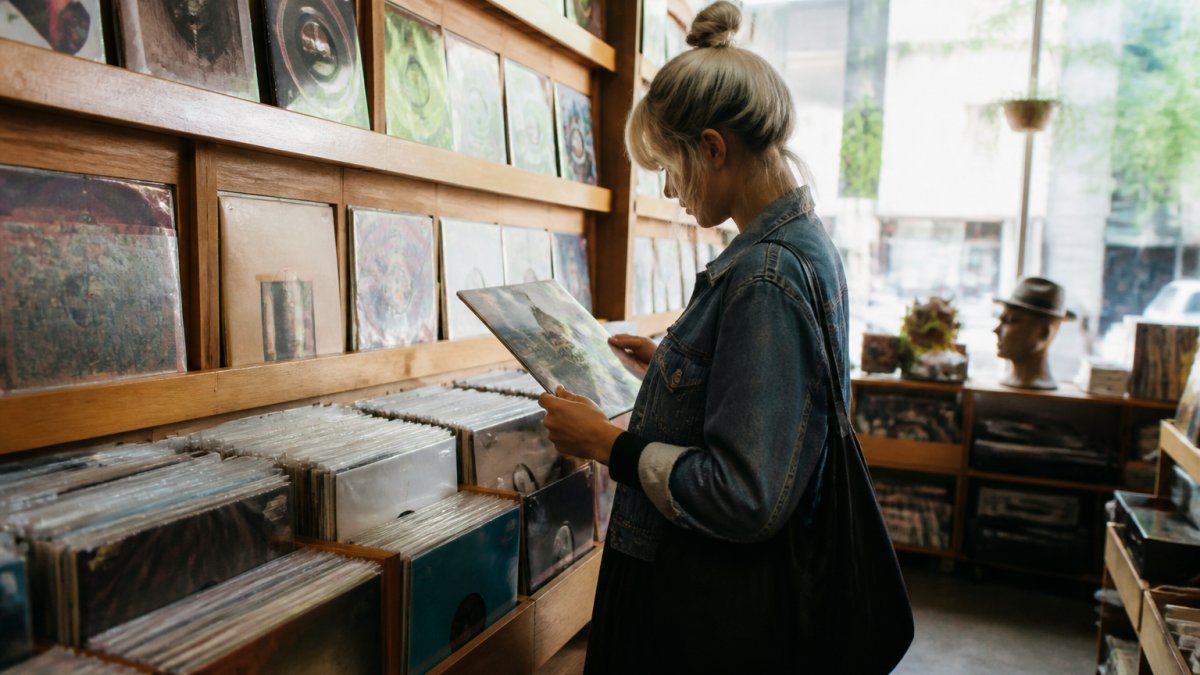
Local record stores also benefit from human curation. Owners stock what they believe in, not what an algorithm predicts will sell. This creates a unique collection at each location. Two record stores in different towns will have completely different inventories. That variation is a feature, not a bug. It rewards exploration and repeat visits.
How to Inspect Used Vinyl Records Before You Buy
Most buyers get burned not because they can’t see a flaw, but because they don’t know what to look for or how to translate a seller’s words into an actual condition. Use the same checklist whether you’re standing in a store or reading an online listing, the difference is that in person you can verify, and online you can only ask.
Step 1: Grade the vinyl, not the sleeve. The record and its cover are graded separately, and sellers sometimes quote only the better of the two. Ask for both grades explicitly. The common scale runs from Mint (essentially unplayed) down through Near Mint, Very Good Plus, Very Good, Good, and Fair. The trap is that “Very Good” is not very good, on most grading scales it already means audible surface noise and visible marks. Treat anything below Very Good Plus as a record with known imperfections, and price your expectations accordingly.
Step 2: Inspect the vinyl surface. Hold the record at a low angle under a strong light and tilt it so reflections sweep across the grooves. You’re looking for three things:
- Scratches you can feel with a fingernail. A mark you can feel will usually tick or skip. A mark you can only see is often inaudible.
- Warping. Lay the record flat on a stable surface or sight down its edge. A visible wave means the stylus may not track cleanly, especially near the outer edge.
- Groove wear and grayness. Dull, grayish patches suggest a record played many times on a heavy or worn stylus. It tends to sound flat and noisy even without visible scratches.
Step 3: Check the label and spindle hole. A ring of wear around the spindle hole, or a label that’s been re-glued or written on, hints at heavy play or a swapped record. A spindle hole that’s been enlarged is a red flag for DJ use.
Step 4: Inspect the sleeve and inner sleeve separately. Corner splits, ring wear, seam splits, cut-out corners, and water stains tell you how the record was stored. A pristine cover with a scratched record is common, and so is the reverse. Original inner sleeves, inserts, and lyric sheets affect value; ask whether they’re included.
Step 5: Ask about playback, not just appearance. The only real test is how it sounds. In a store, ask to play a few seconds of the loudest and quietest passages, the intro groove and the run-out are where problems hide. Online, ask the seller directly: “Have you played this copy end to end? Any skips, repeats, or persistent noise?” A seller who won’t answer a specific playback question is telling you something.
Step 6: Ask about provenance and storage. How long has the seller owned it? Was it stored upright, away from heat and direct sun? Records kept in a hot attic or a damp basement warp and mold regardless of how carefully they were handled.
Pro Tip
In person, you control the inspection and can walk away from a bad copy. Online, you’re relying on a stranger’s grading, so ask for both vinyl and sleeve grades, request playback details, and confirm the return policy before you pay. A listing that answers all three is worth more than one that’s simply cheaper.
In person, you control the inspection and can walk away from a bad copy. Online, you’re relying on a stranger’s grading, so ask for both vinyl and sleeve grades, request playback details, and confirm the return policy before you pay. A listing that answers all three is worth more than one that’s simply cheaper.
How to Find Rare Vintage Vinyl Records
Rare records rarely appear on major online marketplaces. They end up in local shops, estate sales, and specialized dealers who cater to collectors willing to hunt.
Building relationships with local record store staff accelerates the search. Tell them what you’re looking for. They’ll call when something comes in. They’ll hold records for you. They’ll connect you with other collectors. Online, you’re one of millions of customers. In a local shop, you’re a known collector with specific tastes.
Record fairs and swap meets are another channel. These events bring together dealers and collectors in one place. You can examine multiple copies of the same record and compare pressings, condition, and price. Online, you see one listing at a time.
Patience matters more than platform. Rare records take time to find. Local shops reward regular visits. Online searches reward luck. Most collectors who build serious collections do both: they browse online for specific wants and visit local shops for serendipity.
The Community and Expert Knowledge Advantage
Record store staff are curators and educators. They know pressing variations, reissue quality, and which versions sound best. They can explain why an original pressing costs ten times more than a reissue. They can recommend albums based on what you already own.
This knowledge is invaluable when you’re building a collection. Online reviews help, but they’re written by strangers with different preferences and equipment. A conversation with a record store employee is personalized advice from someone who understands your taste.
Local record stores also create community. Regular customers become friends. People gather to discuss releases, swap recommendations, and celebrate new finds. This social dimension doesn’t exist online. You’re not building a community with an algorithm.
Trading In, Selling, and Supporting Local Business
One of the biggest advantages of local record stores is the ability to trade in records for cash or store credit. This creates a circular economy where your collection evolves without constant spending.
Online marketplaces offer selling options, but the process is slow and fees are high. You photograph each item, write descriptions, handle shipping, and manage disputes. Local shops offer immediate payment or credit. You bring in your records, get an offer, and walk out with cash or credit to spend on new finds.
Supporting independent local businesses also matters. Record stores are gathering places for music culture. They employ people who are passionate about vinyl. They curate collections thoughtfully. When you shop locally, you’re investing in that ecosystem.
The choice between local record stores and online shopping isn’t either-or. Most collectors use both. Online shopping works for specific wants and new releases. Local record stores work for discovery, condition verification, and building a community. Understanding when each channel serves you best makes you a smarter collector. Start by visiting a local record store near you, talk to the staff, and explore what they’ve curated. You’ll understand immediately why some purchases are better made in person. For collectors in the area, Greatest Hits Music & Books offers a curated selection of vinyl records and used media where you can browse in person, trade in your collection, and discover your next favorite treasure.
Frequently Asked Questions
What are the benefits of buying vinyl records from a local record store?
Local record stores offer hands-on inspection of vinyl condition, staff recommendations based on music knowledge, the ability to discover unexpected finds through browsing, and the chance to support independent business. You can also trade or sell pre-owned items for cash or store credit, building a relationship with the store over time. Many collectors find the community aspect and personalized service worth the trip.
Can you check a record’s condition before buying it in a store?
Yes. In-person shopping lets you examine the record sleeve, check for warping, inspect the vinyl surface for scratches or dust, and listen to a sample if the store has a listening station. You can assess grading yourself or ask staff for their assessment. Online purchases rely on seller photos and descriptions, making condition inspection much harder before the record arrives.
Is it cheaper to buy vinyl online or at a record store?
Total cost depends on several factors. Online shopping often shows lower per-unit prices but adds shipping costs, potential return hassles, and risk of damage in transit. Local record stores may have higher individual prices but eliminate shipping fees and let you avoid buying damaged stock. Buying used locally and trading in old records can offset costs. Compare the full price including delivery before deciding.
How do I find rare vintage vinyl records?
Local record stores with strong crate-digging communities and knowledgeable staff are excellent sources for rare pressings and out-of-print albums. Staff often know collectors’ wants and can alert you to incoming inventory. Record fairs and in-person browsing let you inspect condition closely. Online marketplaces have broader selection but require careful grading assessment and carry higher return friction if the record arrives damaged or misgraded.