

Sub-Total: $0.00
How to Value Your Vintage Book Collection
Table of Contents
- Why Valuing Your Vintage Book Collection Matters
- How to Identify a First Edition Book
- Old Book Condition Grading and Its Impact on Value
- How to Check the Value of Old Books
- Factors That Affect Your Collection’s Value
- How to Sell a Vintage Book Collection
- Creating a Valuation Inventory for Your Collection
- Frequently Asked Questions
Last Updated: October 10, 2026
Why Valuing Your Vintage Book Collection Matters
Knowing how to value vintage book collection protects you from underpricing your treasures when selling, donating, or insuring.
A first edition in good condition can command hundreds or even thousands of dollars, but condition, rarity, and edition details matter enormously.
This guide teaches you how to identify valuable books, assess condition, research comparable sales, and prepare your collection for sale.
How to Identify a First Edition Book
The most valuable books are typically first editions in good condition. A first edition is the original printing before reprints or new editions. Identifying one requires checking the title page and copyright page.
Checking the Title Page and Copyright Page
Open your book to the title page and copyright page. Look for “First Edition” or “First Printing.” If absent, examine the printing line on the copyright page.
The printing line shows numbers like “10 9 8 7 6 5 4 3 2 1.” If the lowest number is “1,” it’s a first printing.
Understanding Printing Numbers and Edition Statements
Publishers use different systems to indicate editions. Some state “First Edition” directly; others use “First published” with a year. Check your book’s country of origin, as British and American publishers differ.
Books from the 1950s and earlier may lack printing information. Cross-reference the title page year with publisher records or databases.
Old Book Condition Grading and Its Impact on Value
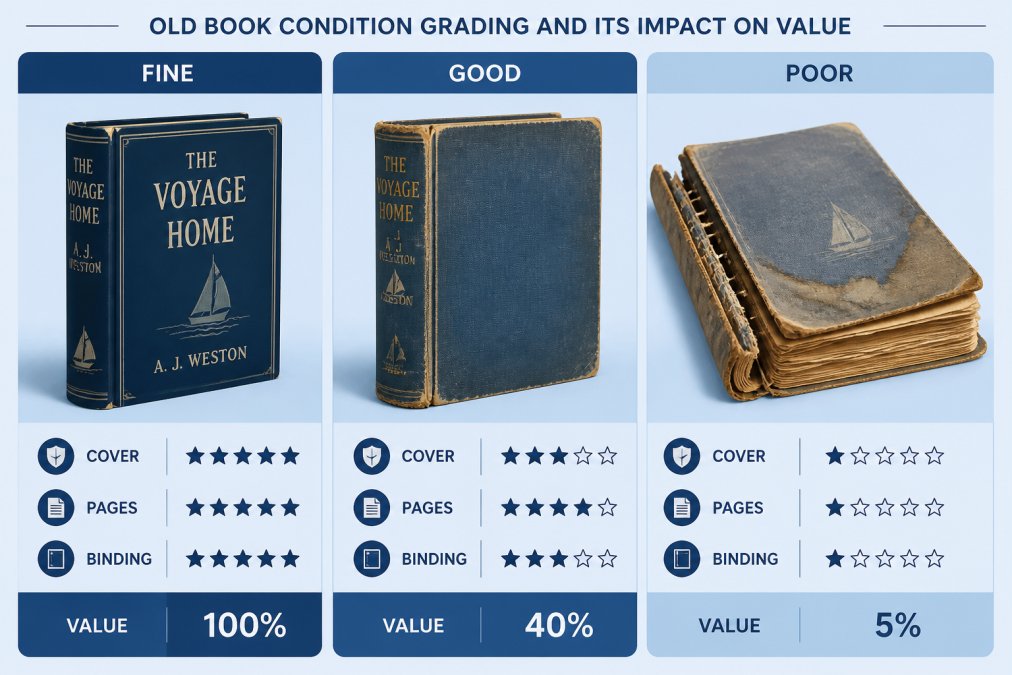
Condition is the single largest driver of value. Two copies of the same first edition can differ by hundreds of dollars based on wear and damage. Consistent grading is essential to accurate valuation.
The Standard Grading Scale and Price Impact
The book trade uses a six-point grading system recognized by dealers, auction houses, and online platforms like AbeBooks and Alibris:
Fine (F): Nearly new; straight spine, clean pages, no dust jacket fading or damage. Commands 80-100% of asking price.
Very Good (VG): Light wear; minor spine creasing, light foxing, minor dust jacket wear.
Good (G): Obvious wear; creased spine, pronounced foxing, bumped corners, visible dust jacket wear.
Fair (FR): Worn; loose binding, yellowed pages, heavy foxing, torn dust jacket.
Poor (P): Damaged but readable; cracked binding, loose pages, missing or severely damaged dust jacket.
Specific Defects and Their Value Impact
Understanding which defects matter most helps you prioritize your collection and set realistic prices.
Binding Integrity: Check the spine and hinges (interior joints where pages attach to the cover).
Page Condition: Loose or missing pages are severe defects. Yellowing is normal in older books.
Cover and Corner Wear: Bumped corners, creased covers, and faded lettering are common in used books.
Creating a Condition Assessment Checklist
When evaluating each book in your collection, use this checklist to assign a consistent grade:
- Dust jacket present? Yes / No. If yes, is it intact, torn, faded, or detached?
- Spine condition: Straight and uncracked (Fine) / Minor creasing (VG) / Visible creasing or cracking (Good) / Cracked or separated (Fair/Poor)?
- Foxing and staining: None (Fine) / Light, edges only (VG) / Moderate throughout (Good) / Heavy (Fair/Poor)?
- Binding integrity: Tight and intact (Fine/VG) / Slight looseness (Good) / Loose or cracked (Fair/Poor)?
- Pages: All present and clean (Fine/VG) / Yellowed or light marks (Good) / Stained or loose (Fair/Poor)?
- Corners and edges: Sharp (Fine) / Slightly bumped (VG) / Visibly worn (Good) / Heavily worn (Fair/Poor)?
Once you’ve assessed each factor, assign an overall grade. If most factors fall into the “Good” range, the book is Good condition. If you see a mix of VG and Good, it’s likely VG. This consistency helps you price your collection fairly and defend your valuations if you sell online or to a dealer.
Why Condition Grading Matters for Your Total Collection Value
A first edition in Fine condition might sell for $800. The same book in Very Good condition might fetch $500. In Good condition, $250. In Fair condition, $75. This variance is why honest condition assessment is critical. Overgrading your books leads to unsold listings or returns.
How to Check the Value of Old Books
Once you’ve identified your books and graded their condition, it’s time to research actual market values. This involves checking online marketplaces, databases, and completed auction records to see what similar books have actually sold for.
Using Online Marketplaces and Databases
Search your book on AbeBooks, Alibris, or ViaLibri. Enter the exact title, author, and publication year, filtering by edition and condition. Remember, asking prices differ from actual sale prices.
Google Books and Library of Congress records verify publication details and first edition status. WorldCat shows library holdings; few holdings indicate scarcity.
Researching Comparable Sales and Auction Records
Auction sites like Heritage Auctions and Sotheby’s publish realized prices. Check eBay’s “sold listings” filter for completed sales. Keep notes on comparable sales; average recent prices to estimate value. Recent sales matter more than old ones, as values fluctuate with collector interest.
Factors That Affect Your Collection’s Value
Several factors beyond condition and edition determine whether a book is worth $5 or $500. Understanding these factors helps you prioritize which books to research first and which may have limited market appeal.
Rarity and Collector Demand
Limited print runs make books rare and valuable. A book printed 5,000 times is scarcer than one printed 100,000 times. However, rarity alone doesn’t guarantee value, collector demand matters. Rare first editions by famous authors, books on popular collecting topics (science fiction, mystery, Nobel Prize winners), classic literature, signed copies, and books with historical significance command higher prices.
Provenance and Signed Copies
A signed copy by the author is worth significantly more than an unsigned copy. Provenance (documented ownership history) matters if the previous owner was notable. Books from celebrity collections or with interesting backstories attract collectors and command higher prices.
How to Sell a Vintage Book Collection
Once you’ve valued your collection, you’ll need to decide how to sell it. Different sales channels work better for different types of books. Understanding your options helps you maximize returns.
Choosing Between Local Dealers and Online Sales
Local dealers offer immediate payment (typically 20-40% of retail value) but require less effort. Online sales through AbeBooks or eBay take more time but yield higher prices. For rare or valuable books, the extra effort pays off. For common books under $10, the time investment rarely justifies the return.
Preparing Your Books for Sale
Clean books gently with a soft brush; never use water or harsh chemicals. Photograph the cover, spine, title page, and any damage or signatures. Write detailed descriptions mentioning edition, condition, damage, and dust jacket status. Package carefully with tracking and insurance for valuable items.
Creating a Valuation Inventory for Your Collection
A detailed inventory is the foundation of defensible valuation for insurance claims, estate planning, tax donations, and sales negotiations.
The Valuation Worksheet: A Book-by-Book Framework
Create a spreadsheet with these essential columns: Title, Author, Publication Year, Publisher, Edition/Printing, Dust Jacket status, Condition Grade, Specific Defects, Provenance/Notes, Comparable Sales (3 entries with date and price), Average Comparable Price, Estimated Fair Market Value, Insurance Replacement Value, and Notes.
Understanding Different Valuation Types
Different contexts require different valuations. Using the wrong one can lead to underpayment, overpayment, or tax problems.
Fair Market Value (FMV): The price at which a book would sell between a willing buyer and seller, neither under pressure.
Donation Value: For charitable donations, use FMV as of the donation date. The IRS scrutinizes donations over $5,000 and may require a qualified appraisal (Instructions for Form 8283 (12/2025)).
Liquidation Value: For quick sales, expect 40-60% of FMV when selling to a dealer, or 60-80% of FMV when selling online yourself.
Building Your Comparables Database
The accuracy of your valuation depends entirely on the quality of your comparable sales research. Here’s how to build a defensible comparables database:
- Search multiple platforms: AbeBooks, Alibris, ViaLibri, eBay (sold listings), and specialized auction sites (Heritage Auctions, Sotheby’s, Christie’s).
- Filter by edition and condition: Only compare first editions to first editions, and match condition grades as closely as possible.
- Prioritize recent sales: A sale from the past 6 months is more reliable than a sale from 2 years ago. Book values fluctuate based on collector interest and availability.
- Document the source: Record the platform, seller, date, and final price for each comparable. This creates an audit trail if your valuation is questioned.
- Account for fees and shipping: If you find a book that sold on eBay for $300, subtract eBay’s 12.9% fee plus shipping (typically $10-20 for a book). The seller’s net proceeds were closer to $250. For FMV, use the gross sale price, but be aware that the seller netted less.
- Identify outliers: If you find one sale at $1,000 and five sales at $200, the $1,000 sale may be an outlier (perhaps a signed copy or exceptional condition). Use the median or average of the five $200 sales as your comparable.
Organizing Your Inventory for Different Purposes
Once you’ve built your spreadsheet, you can use it for multiple purposes:
For Insurance: Print or export the inventory with Fair Market Value and Insurance Replacement Value columns. Provide this to your insurance agent. Update it annually or whenever you acquire or sell significant books. Many homeowner’s policies cap coverage for books at $2,500-$5,000, so a high-value collection may require a separate rider or specialized collectibles policy.
For Estate Planning: Include the inventory in your will or estate documents. Your heirs will know what the collection contains and what it’s worth, which simplifies probate and prevents disputes.
For Tax Donations: If you’re donating books to a library, school, or nonprofit, use the FMV column to calculate your tax deduction.
For Sales: When selling online or to a dealer, use your inventory to:
- Identify which books merit individual listings (high value, strong demand)
- Batch lower-value books for bulk sales
- Set realistic asking prices based on comparables
When to Seek a Professional Appraisal
Seek a qualified appraiser (member of AAA or ASA, specializing in rare books) for high-value collections (over $10,000), rare or specialized books, tax donations over $5,000, estate disputes, or insurance claims. Expect $100-$300 per hour or $500-$2,000 flat fee.
Updating Your Inventory Over Time
Review your inventory annually. Update comparable sales prices for valuable books, remove sold items, and add acquisitions. This keeps insurance coverage current and ensures estate documents reflect reality. A well-maintained inventory defends against undervaluation and guides informed decisions about your value vintage book collection.
Frequently Asked Questions
How do I tell if an old book is worth anything?
Check three things: edition status (first editions are typically worth more), condition (pristine books command higher prices), and rarity (how many copies exist and current collector demand). Research comparable sales on online marketplaces and auction records. A first edition in fine condition of a popular author may be worth hundreds, while a later printing in poor condition might be worth just a few dollars. Use online databases to cross-reference your book’s title, author, and publication details against sold listings to estimate fair market value.
What factors most affect how to value my vintage book collection?
The primary factors are edition and printing (first editions typically worth more), publication date, author reputation, rarity and collector demand, condition grading, and provenance (ownership history or signatures). A signed copy by the author increases value significantly. Dust jacket presence and condition also matter, a first edition with an intact dust jacket can be worth 10 times more than without one. Condition grading directly impacts price; a fine copy sells for far more than a good or fair copy of the same book.
How do I identify a first edition book?
Check the copyright page (usually the back of the title page) for edition statements. Most first editions say ‘First Edition’ or show ‘1’ in the printing line. Look at the title page for publication details. Different publishers use different methods, some list printing numbers (1 2 3 4 5 means first edition), others use edition statements. Verify against online databases like AbeBooks or ViaLibri, which catalog first edition details. If unsure, compare your book’s physical characteristics (dust jacket design, binding style, paper quality) against confirmed first editions of the same title.
What’s the best way to sell a vintage book collection?
For high-value individual books, online marketplaces like AbeBooks or eBay reach serious collectors willing to pay fair prices. For bulk collections, local book dealers often purchase entire lots at a discount for speed and convenience. Get multiple quotes, dealers may offer 25-50% of estimated retail value depending on demand and condition. Consider consignment if you have rare items; you earn more but wait longer. Estate sales work well for mixed collections. Always verify buyer credentials and compare offers before committing. Factor in shipping costs and time investment when deciding between selling individually or in bulk.